
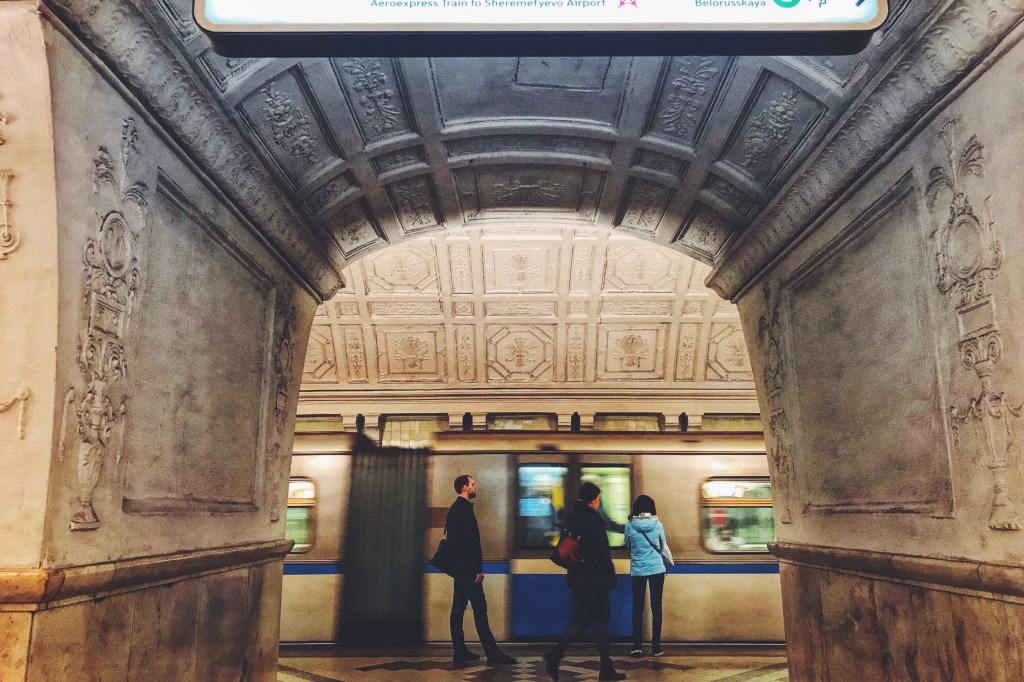
When it comes to efficient transportation, Moscow’s metro system does more than just shuttle people from one point to another. Each station is a portal to Russia’s rich history and a masterpiece of art and architecture. The Moscow underground stations are not only an essential part of the city’s daily rhythm but have also become major tourist attractions in their own right. A trip on the Moscow Metro, which costs around USD 0.84 per ride, is like traveling through a historical museum, with every stop offering a unique glimpse into the country’s past.
One weekend morning, I decide to follow Lonely Planet’s itinerary for the metro tour, stopping by 10 stations considered the most beautiful. From Belorusskaya, near where our hotel is located, I ride the Sokolnicheskaya line four stations east to the starting point, the Komsomolskaya.

Komsomolskaya: Moscow’s Gateway Underground Station
Komsomolskaya is one of the most iconic Moscow underground stations, located beneath the bustling Komsomolskaya Square. Dubbed the “gateway station of Moscow,” this station is an architectural marvel, adorned with elegant bronze chandeliers, marble arcades, and mosaic panels inspired by ancient temple architecture. It’s one of the finest examples of the grandeur that defines many Moscow underground stations.

Prospekt Mira: A Botanical Journey Under Moscow
Next, I arrive at Prospekt Mira, a station originally called “Botanical Garden” after the nearby Moscow University’s garden. The station’s design beautifully reflects a botanical theme, celebrating the Soviet Union’s agricultural history. Floral elements blend seamlessly with the story of Soviet development, making this Moscow underground station both visually and historically fascinating.

Novoslobodkaya: The Stained Glass Masterpiece
Novoslobodkaya is a unique stop on the Moscow underground tour, renowned for its stunning stained glass panels. These panels, designed by Pavel Korin, were created in Latvia, as Russia did not have a tradition of stained glass. The colorful compositions showcase beautiful designs, making this station one of the most artistic in Moscow.

Belorusskaya: A Nod to Belarusian Heritage
Returning to Belorusskaya, the station closest to our hotel, I marvel at its design, which features octagonal mosaics that reflect the rich cultural heritage of Belarus. The floor tiles are designed to resemble a Belarusian quilt, adding an extra layer of cultural depth to this already beautiful Moscow underground station.

Mayakovskaya: The Stalinist Gem
Mayakovskaya, located on the Zamoskvoretskaya Line, is often hailed as one of the most beautiful stations in Moscow. Its Stalinist architecture is awe-inspiring, with intricate design elements and symmetrical patterns that reflect the style of the era. The station is a true gem of the Moscow underground system.

Teatralnaya: A Theatrical Underground Experience
Next, I arrive at Teatralnaya, named after the Teatralnaya Square, home to the historic Bolshoi Theatre. The station’s central hall vault is adorned with bas-reliefs depicting figures from the world of music and dance, representing the diverse nationalities of the Soviet Union. This station is a true celebration of Moscow’s rich cultural heritage.

Ploschad Revolyutsii: Revolution and Art in the Moscow Underground
Ploschad Revolyutsii is named after Revolution Square and features a series of arches flanked by bronze sculptures depicting people of the Soviet Union. The highlight of this station is the sculpture of a man with a rooster, a figure commuters rub for good luck. This artistic station is an essential stop on any tour of the Moscow underground.

Arbatskaya: Moscow’s Nuclear Bunker Station
Arbatskaya is a historically significant Moscow underground station, built in 1953 to replace a previous station that was destroyed during the German attack in 1941. The new station was constructed much deeper and larger, making it a dual-purpose station that could also serve as a nuclear bunker in times of crisis.

Kievskaya: Ukrainian Baroque in Moscow’s Metro
Kievskaya, named after the Ukrainian capital, features quasi-baroque ceilings adorned with frescoes that depict traditional Ukrainian life. The design of this Moscow underground station is a nod to the close cultural ties between Russia and Ukraine.

Park Pobedy: Moscow’s Deepest and Longest Underground Station
Finally, I reach Park Pobedy, the deepest metro station in Moscow, located 84 meters underground. The station boasts the longest escalators in Europe, measuring a staggering 126 meters long. The design of Park Pobedy is more modern and futuristic compared to the other stations, and it serves as a gateway to the Victory Park, which commemorates the Soviet Union’s victory in World War II.
From the station, I exit to the Victory Park, which commemorates the Soviet victory in World War II. I explore the area for a bit before entering the station again and retracing my steps back to Belorusskaya.
More than mere transportation hubs, the Moscow underground stations are living museums that showcase the country’s rich history, art, and culture. Each station tells a unique story, from the grandeur of Komsomolskaya to the botanical beauty of Prospekt Mira and the cultural richness of Belorusskaya. If you find yourself in Moscow, don’t miss the chance to explore these historic underground stations that have become landmarks in their own right.
 The Tourist Gaze
Leave a comment