
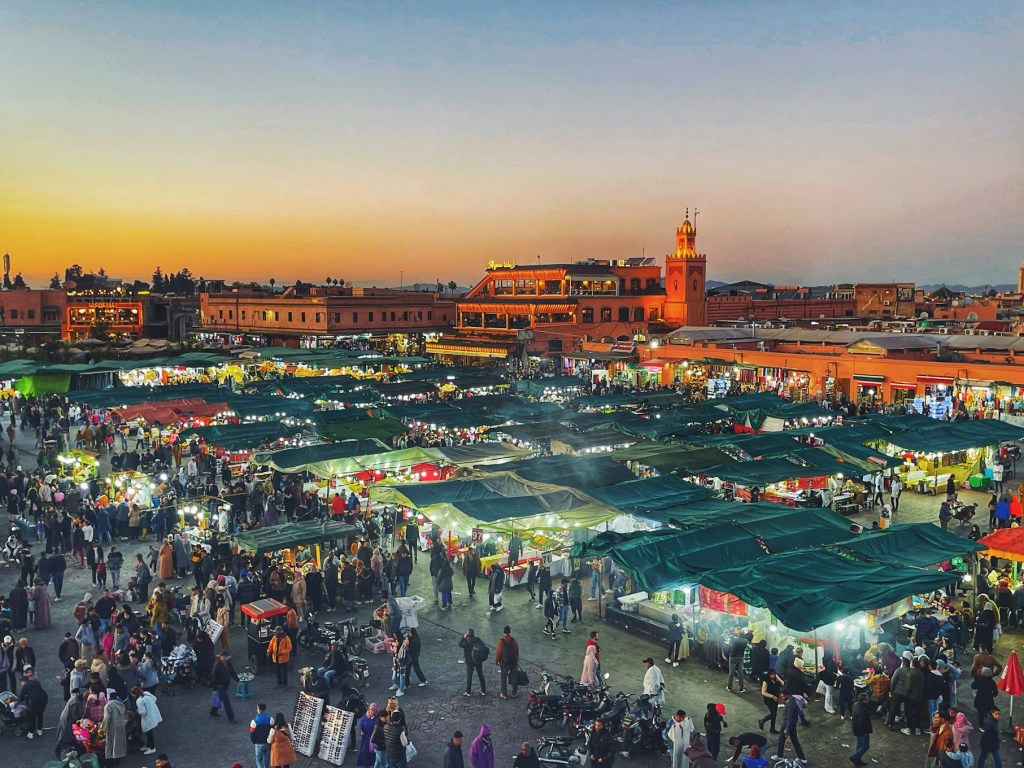
We arrive in Marrakesh at just after sunset. The van drops me at the southern gate of the medina, which turns out to be a bit farther from my hostel than expected. But it does require me walking through the Jemaa el-Fnaa, the main square in the medina and the star attraction of Marrakesh. The size of the place and the bustle occurring at this particular dusk have me excited to explore right away. But my prime concern is to check in my accommodation (which, as with the previous stops, is inside the medina), eat dinner, and buy a train ticket to Casablanca (my next destination), so I do the exploring the next day.
Marrakesh has a rich and storied history dating back over a thousand years. Founded in 1062 by the Almoravid dynasty, the city served as the capital of their empire and quickly became an important center of trade, culture, and religion in North Africa. During the medieval period, Marrakesh flourished under various dynasties, including the Almohads and the Marinids, and witnessed the construction of magnificent palaces, mosques, and gardens, which still stand as testaments to its historical grandeur. Notably, the Koutoubia Mosque, with its iconic minaret, was built during this period and remains an emblematic symbol of the city.
After experiencing a decline in the 16th century, when the capital was moved to Fes, Marrakesh then regained prominence during the Saadian dynasty. In the 20th century, the city became part of French Morocco and saw the development of modern infrastructure and urban planning. After Morocco gained independence in 1956, Marrakesh continued to grow as a cultural and tourist destination, attracting visitors from around the world. Today, Marrakesh preserves its historical legacy while embracing modernity.


I do my exploration of Marrakesh early the next day. I first go to the Jardin Majorelle in Ville Nouvelle, about a 30-minute walk northwest from my hostel (I’m saving my remaining cash and figuring I need a morning exercise anyway). The Jardin Majorelle was a property of French Orientalist artist Jacques Majorelle until the 1950s, when it was sold following his divorce, and the garden fell into neglect. Fashion designer Yves Saint-Laurent and his partner Pierre Bergé purchased it in the 1980s and restored it. Today, the garden contains about 300 species of plants from around the world. The centerpiece of the garden, though, is the distinctly blue structure that houses the Berber Museum, which shows an assortment of Berber artifacts. The displays are in French, though, so non-French-speaking visitors might find themselves less enlightened than their French-speaking counterparts.
Near the garden is the Yves Saint Laurent Museum. Opened in 2017, the museum pays tribute to the works of the venerated fashion designer through photos, sketches, and thousands of accessories and garments from his personal collections.


Back in the medina, I start my exploration of the area with a visit to the Bahia Palace. The palace was originally built in the 19th century for Grand Vizzier Si Musa, and then was expanded by his son, Ba Ahmed, who also succeeded him after his death. The palace compound contains a central garden, a mosque, and a hammam. Today, it’s a popular attraction in Marrakesh, with various tour groups overwhelming every portion of the palace.
Eager to immerse myself in the atmosphere of the medina, I mostly spend the rest of the day exploring its alleys. At one point I unexpectedly run into Holga and Michelle, the German couple I was with in the trip to Erg Chebbi. We briefly exchange stories of our adventures going to our respective hostels the previous evening before saying farewell again to do our own separate explorations.
As I weave my way through the crowds, the medina’s vibrant energy envelops me as I encounter artisans practicing their crafts, customers haggling over prices with local vendors, and other tourists simply indulging in the sensory delights of the city. Then I do my own bit of shopping, entering a shop to buy Moroccan bath salt and soap. Finally, I stop by the Le Jardin for a lunch of couscous before retreating to the hostel to rest for a bit.


After about an hour or so, I resume my tour, this time focusing on the area close to the Jemaa el-Fnaa. It’s already late afternoon, and the bustle of the square is beginning to pick up. Snake charmers, shirt and bracelet vendors, faux guides, traders, and visitors — the world seems to be descending on the place. I climb to the rooftop of Le Grand Balcon at the southeastern part of the square for a panoramic view. Admission to the balcony requires buying a drink, so I buy a can of Pepsi Max, which I nurse at a table that just got empty as I wait for the sunset.
As night falls, I eagerly venture into the bustling stalls that populate the square. The aroma of various culinary delights fills the air, tempting my taste buds. I want to indulge in a meal from one of the stalls, but my budget requires me to be mindful of my spending after the Sahara tour depleted my cash reserves. So I decide to return to Le Jardin, where I can conveniently use my credit card for payment. Surprisingly, one of the servers recognizes me. “Oh, you’re back!” she exclaims, typifying the warm and inviting ambiance of the place.
This time, I order tanjia, a Marrakshi specialty renowned for its slow-cooked meat, typically beef, prepared in a clay pot that lends the dish its name. Often referred to as the “bachelor’s dish,” the tanjia was traditionally cooked by single men. Its simplicity in terms of ingredients and cooking methods made it an easy and satisfying meal choice for those who had spent their days toiling at the souks. As I settle the bill at the front desk after the meal, the staff at the cashier asks about my experience at the restaurant. With a genuine smile, I express my delight, saying, “I love it! In fact, this is my second visit to this wonderful establishment today!” While the convenience of using my card undoubtedly plays a role in my return, it is not entirely the reason — I find comfort in the delicious flavors and welcoming atmosphere as well.

 The Tourist Gaze
Leave a comment