
The next day, we leave Amman early for Petra, one of the New Seven Wonders of the World. Petra is a breathtaking archaeological marvel carved into Jordan’s rose-red sandstone cliffs. Once the thriving capital of the Nabatean Kingdom, an ancient Arab group who inhabited the region, Petra was a major hub along the ancient spice and incense trade routes connecting Arabia, Egypt, and the Mediterranean.
We arrive at the entrance just after lunch at a nearby hotel restaurant, and soon we’re walking on our way to the site.
The Siq: Gateway to the Lost City
A few minutes from the entrance and we arrive at entrance to the narrow Siq canyon. The Siq (Arabic for “shaft”) is a 1.2-kilometer-long natural gorge that serves as the grand entrance to Petra. Lined with remnants of ancient carvings, water channels, and spiritual symbols, it was once an essential part of the city’s sophisticated water system.
As the day reaches the golden hour, warm hues cast deep shadows across the towering rock faces, illuminating them with a soft, fiery glow. I imagine the past, weaving through ancient caravans and traders bustling with goods, finally reaching the iconic Treasury, where the massive, intricately carved monument stands as a testament to the ingenuity and artistry of a civilization long gone.
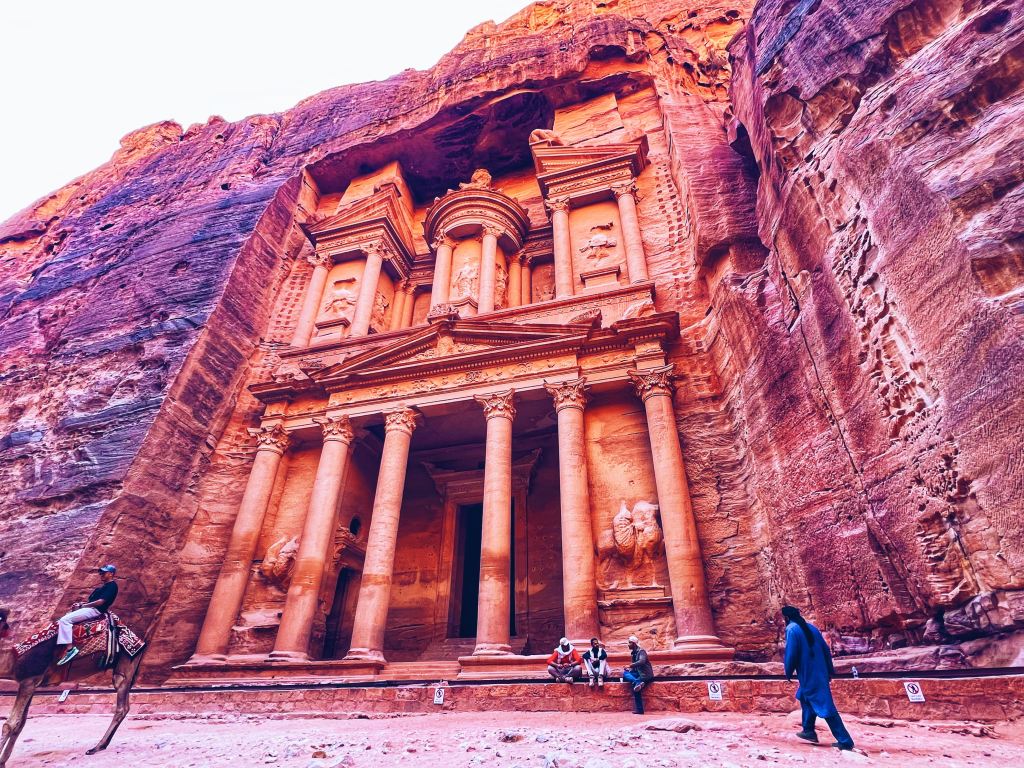
The Treasury is Petra’s most recognizable landmark, its soaring facade welcoming us following our journey through the narrow Siq canyon. Its architecture combines Eastern and Hellenistic architectural styles carved straight into the rose-red sandstone cliffs around the first century BCE. Petra was conveniently located along the incense and spice routes that connected Arabia, Egypt, and the Mediterranean, making it an important commerce hub for the Nabateans.


The Treasury: Petra’s Crown Jewel
Emerging from the Siq, the Al-Khazneh (The Treasury) looms before me. This 40-meter-high façade, carved directly into the rock around the 1st century BCE, is Petra’s most famous landmark.
Although it’s called the Treasury (“Al-Khazneh” in Arabic), its purpose remains actually mystery. Local legends once held that the imposing urn carved at the top contained hidden treasures left by ancient pharaohs or bandits, giving the structure its name. However, Louie says this is a misnomer: it was probably a royal mausoleum meant for a Nabatean king or other dignitary. The Corinthian columns, statues, and friezes of the building exhibit a Hellenistic influence, demonstrating the Nabateans’ exposure to and assimilation of Greco-Roman traditions, while the Eastern style shows preservation of their own character.
In 1985, the Treasury was designated a UNESCO World Heritage Site, and today it continues to stand as a testament to Petra’s timeless beauty and mystery. Despite a decline in overall tourist arrivals in Jordan as a result of the Middle East conflicts, Petra nevertheless attracts tourists from all over the world who are awestruck by the inventiveness of a civilization that survived in the hostile desert environment. The building is–to use a trite adjective for lack of a better word–a breathtaking sight, especially at sunrise and sunset when the light and shadow play across its exquisite carvings, changing the color of the pink-hued stone.


Beyond the Treasury: Exploring Petra’s Other Landmarks
As I get deeper into Petra, I see an amphitheater, temples, and tombs that are all perfectly incorporated into the natural cliffs. “This was a thriving hub of commerce and culture,” according to Louie. “People traveled from as far as Arabia and Egypt to trade here.” The idea of a thriving civilization in this obscure desert valley is quite unthinkable, and Petra shows how resourceful and tenacious the Nabateans were in finding beauty and prosperity in one of the harshest environments on earth.
Louie gives the group about an hour to explore the place up to the theater. “I’ll meet you at the visitors center at 4,” he tells us.


To truly experience the wonders of Petra inside, it’s essential to take the time to walk beyond the familiar sites. I wander off slowly as the group breaks off from each other to explore. I pause often, trying to take a shot with my phone of every detail, every carving. The magnitude of Petra is almost too much to absorb in one visit (“You need at least four days to fully explore Petra,” Louie at one point said in the bus); still, I find myself drawn deeper by the mystery that surrounds these ancient walls.
Petra amazes me with how it blends the work of nature and human ingenuity. The way the Nabataeans built temples and tombs into the natural landscape, with its striking sandstone cliffs and valleys, is a remarkable example of this harmony. Not only did they make use of the area’s natural beauty, they also made sure to protect it for future generations.
At 3:30 PM, I begrudgingly leave the place and make my way back to the visitor’s center.
 Out-of-School Routes
Leave a comment