Iad greets us the next morning with the good news: the Ministry of Tourism has finally allowed us to conduct the baptism ceremony. The bad news: the area around the Sea of Galilee has still some vague security concerns. So instead of the baptism being held at Yardenit, we’re going to hold it at the Qasr el Yahud, near Jericho in the West Bank, further south.
After breakfast, we ride the bus and leave our hotel in Nazareth and head straight to the highway that will bring us to the West Bank. About an hour later, following a short toilet break at a gasoline station, we reach the ancient city of Beit She’an. Iad decides to stop here and allow us to explore the site a bit to make up for the cancelled boat ride (which the Ministry of Tourism hasn’t given a go signal for). The adjustment in the itinerary also means Iad has to scrap the trips to Caesarea and Haifa, which are in the opposite direction of where we’re heading from Nazareth, and would need at least an additional half day to drive to.
So here we are. Beit She’an is one of Israel’s most remarkable and well-preserved ancient cities, with layers of history dating back thousands of years. Situated in the Jordan Valley near the convergence of the Jezreel Valley, it boasts ruins from numerous civilizations, including Egyptians, Canaanites, Israelites, Greeks, Romans, and Byzantines. Its strategic location made it an essential site for trade, military campaigns, and cultural exchanges.


Beit She’an appears in the Bible, most notably as the place where the bodies of King Saul and his sons were displayed on the city walls after their defeat by the Philistines (1 Samuel 31). It was later captured by the Israelites and integrated into the Kingdom of Israel.
Under the Greeks and later the Romans, Beit She’an became part of the Decapolis, a group of ten cities known for their Greek culture. It flourished during the Roman period, becoming a luxurious city with grand structures like a theater, amphitheater, bathhouses, temples, and colonnaded streets.
The city reached its zenith during the Byzantine era. As Scythopolis (its Greek name), Beit She’an was a bustling metropolis with a thriving Christian community and many impressive buildings.
A devastating earthquake in 749 CE led to Beit She’an’s decline. Much of the city was buried under rubble, and it lay in relative obscurity until archaeological excavations began in the 20th century. Today, it is a national park and one of Israel’s most important archaeological sites.


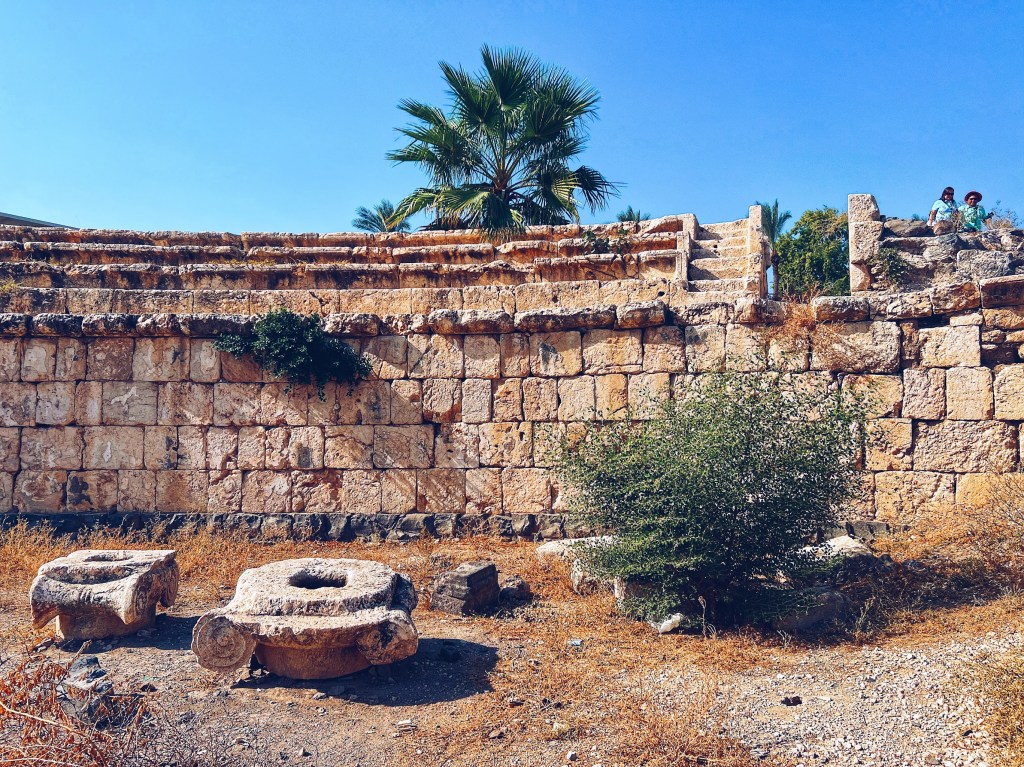
However, much of the structures are under a restoration project, so the park is temporarily closed to visitors. For now, only the hippodrome, located just outside the main park area, remains open for exploration. Nevertheless, this crumbling arena offers a glimpse into the grandeur of Roman entertainment and the historical significance of the city.
After a few minutes walking around the hippodrome and taking pictures of stone walls, ancient seating rows, and the sunlit arena where chariots once raced, we head to the bus to make our way to the West Bank.
 The Tourist Gaze
Leave a comment