Our group sets off at about 11 am, and as we leave Mount of Olives, the landscape opens to the arid expanse of the Judean Desert. It’s the Shabbat as well, and Jews aren’t allowed to drive on this day, so the highways are almost empty.
About an hour later, we stop at a roadside restaurant just before entering Jericho for lunch. The main meal is makloubeh, a classic Middle Eastern dish of rice, vegetables, and tender meat, cooked together and flipped upside down before serving (similar to the one we had in Jordan a couple of days ago except that one had potatoes and had a brownish color, whereas this is more yellowish). I easily consume my first helping and help myself to a second serving. Afterwards, one of the restaurant staff offers me a third plate. Already stuffed (not to mention slightly constipated), I politely refuse. The head staff raises an eyebrow, asking if I truly enjoyed it. I assure them that I did, but they seem half-heartedly satisfied by my response.


After lunch, we go to Jericho’s center. The city heralds itself as one of the oldest inhabited towns, with archaeological proof of human habitation dating back more than 10,000 years. Natural springs from the lush Jordan Valley supplied fresh water in an otherwise parched area, and this allowed Jericho to emerge as an early center of civilization. It was one of the first locations where nomadic people settled in, and the city flourished as a center of trade and agriculture thanks to this consistent supply of water.
By at least 8,000 BCE, Jericho was already ringed by defensive walls, making it one of the earliest fortified cities ever discovered, according to our guide Iad. Archeologists believe that these old walls were most likely constructed to shield its inhabitants and resources, as Jericho has always been strategically important due to its location at the intersection of Egypt, Mesopotamia, and the Levant. The city experienced periods of prosperity, but it was prone to invasions and conquests from empires vying for control of this territory.
Jericho’s ancient past is interwoven with biblical history as well. According to the book of Joshua, it was the first city the Israelites overran after crossing the Jordan River. The narrative of the collapse of the walls of Jericho has come to represent faith and divine intervention.
Today, there are about 25,000 people living in Jericho, a small but lively city on the West Bank. Much of the city’s economy hinges on tourism, with visitors drawn to its biblical and historic monuments. Furthermore, its fertile ground and proximity to natural springs make it an oasis in the desert, where luxuriant date palm groves thrive.


We wind through a couple of roundabouts until we reach the famed sycamore tree associated with Zacchaeus, the tax collector from the New Testament. Iad, our guide, tells us this tree is believed to be the very one Zacchaeus climbed to catch a glimpse of Jesus, although I’m not sure if sycamores can really last a couple of millennia. The tree stands tall in the middle of a courtyard belonging to a Russian Orthodox Church. Unfortunately, we can only admire it from the bus, as Iad hadn’t obtained permission to enter. I and a few of my tourmates content ourselves with snapping a few pictures through the bus’ windows.

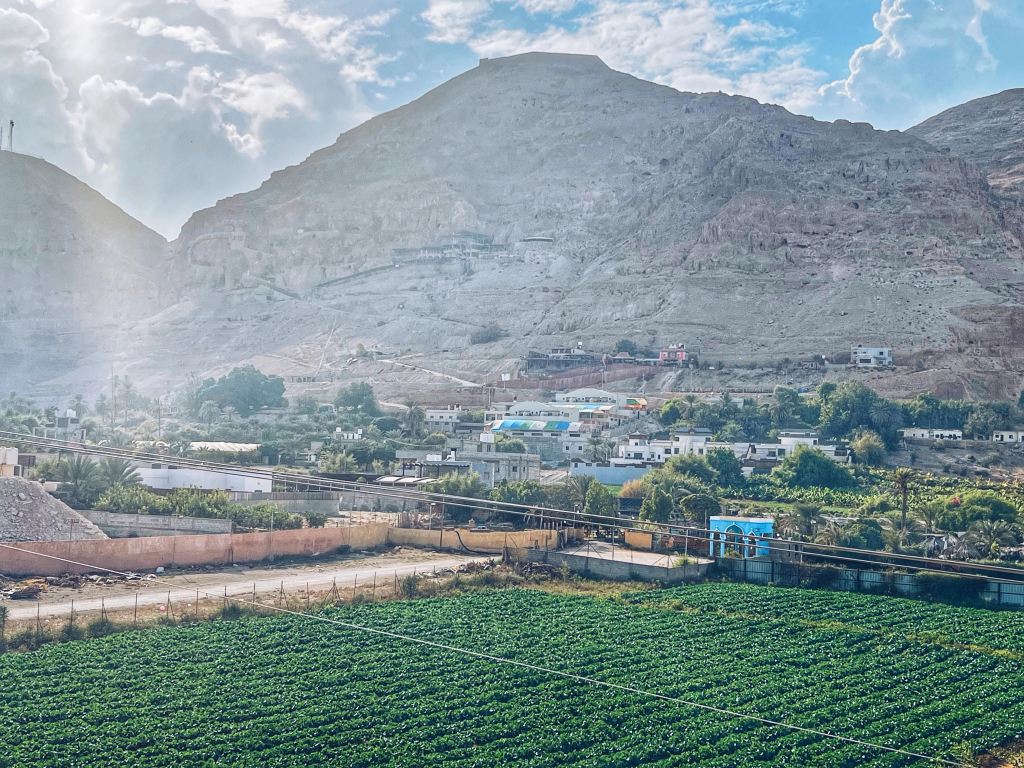
Our next stop is the Mount of Temptation, a looming peak above the city where, according to tradition, Jesus was tempted by the devil. Rising more than 1,200 feet above sea level, the mountain offers sweeping views of the Jordan Valley and the Dead Sea. At its heights sits the Monastery of the Temptation, an ancient Greek Orthodox monastery built into the cliffside. This monastery, first established in the Byzantine era, has been rebuilt and preserved over centuries, and today remains a site of pilgrimage and quiet reflection. Beyond its biblical significance, the Mount of Temptation also provides a glimpse into the region’s natural beauty and stark desert landscape.


I anticipated climbing the mountain by cable car to see the monastery up close, but it turns out our visit is limited to the viewpoint below. We take a few photos, capturing the sweeping views of the Jordan Valley, before we are directed to the neighboring shops aimed for tour groups like ours. One store sells Dead Sea cosmetics—mud masks and mineral scrubs that promise restorative powers. Another offers dates, sweets, and an array of keepsakes from Jericho.
Disappointing, but it’s the price of joining a group tour. And, hey, better to have had a view from afar than not having viewed the mountain in person, right?
Finally, we board the bus to head to a beach by the Dead Sea, our last destination for the day.

 The Tourist Gaze
Leave a comment