This morning–our first in Cairo after a relaxing sleep at the hotel following a long drive from St. Catherine–the sun casts a warm glow over the desert and glints off the pyramid’s limestone. We’re standing at the base of an imposing pyramid, the most famous symbol of Egypt and a UNESCO World Heritage site.
Even though the ancient Egyptians built over 107 pyramids for their royalties, it’s the Pyramid of Khufu (or Cheops, as our guide Michel would prefer to call him) that really stands out as the ultimate symbol of their civilization—probably the most iconic man-made structure ever. When I first step into its shadow and look up at the massive gallery, it feels like it reaches all the way to the sky.
Built for the pharaoh who ruled during the Fourth Dynasty of the Old Kingdom, around 2580–2560 BCE, the pyramid originally rose to a height of about 146.6 meters. Over time, the smooth limestone casing was removed, and it now stands at 138.8 meters. According to Michel, during the Medieval period, especially during the reign of Muslim leader Saladin, the highly polished limestone casing stones were seen as a valuable resource, and many of them were taken for use in mosques, palaces, and other important buildings in Cairo, such as the Al-Azhar Mosque and the Sultan Hassan Mosque. Still, the pyramid remains imposing even without its original coating.


In fact, as we move closer, the intricacies of the stonework become more visible, revealing the ingenuity of ancient engineers. I imagine the laborers who toiled under the blazing desert sun, hauling these colossal stones into place thousands of years ago. “The ancient Egyptians transported these stones using water from the Nile,” Michel tells us, his voice almost drowned by the incessant chatter of visitors from around the globe and the laughter of Egyptian schoolchildren on field trips. “They poured the water ahead of the sledges to dampen the sand, creating a smoother path to transport these massive blocks.”


As I climb the corridor, I pause to touch the smooth limestone walls, imagining the pharaohs who might’ve passed this way centuries ago. Tourists jostle for their pictures, and I patiently wait for gaps to open in the bustling scene to get a clear shot. This close, the enormity of the pyramid is clearer.
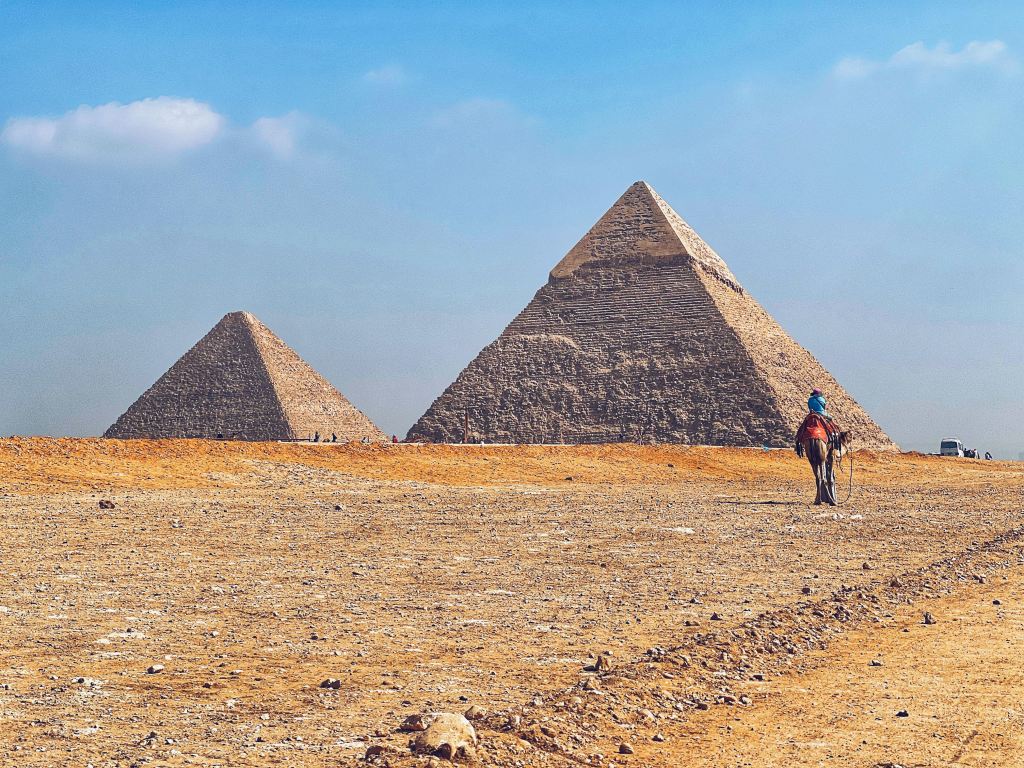
After we’ve had our fill of trying to clamber up the sides of the pyramid, we’re led back to the bus to go to the panoramic viewpoint (only to realize later that the actual panoramic viewpoint is about a few minutes’ walk farther — most of my shots show only two of the pyramids). The landscape consists of sand stretching as far as the eye can see, their golden hues heightened by the relentless sun. In the distance, the other pyramids of Giza—the Pyramid of Khafre and the Pyramid of Menkaure—stand proud, their jagged silhouettes framed by the clear blue sky. To one side, the sprawling city of Cairo is a distant blur, its skyline barely visible against the horizon, while to the other, the desert seems to go on forever, an expanse of soft, undulating sands.


Some members of the group have mounted camels and make their way across the sandy terrain with their camel drivers. I, on the other hand, immediately begin snapping photos from every angle and camera setting I can think of–high-key, low-key, moving between wide shots of the entire plateau and close-ups of each pyramid, shots of just the pyramid, shots of the pyramid with a camel on the foreground.


About an hour later, we hop back onto the bus and drive toward the Sphinx. The landscape changes, with the pyramids still visible in the distance but now becoming smaller. The road is lined with more tourists and vendors selling souvenirs. The Sphinx looms ahead, its immense presence and mysterious gaze commanding attention. Its lion body stretches out, and its pharaoh head watches over the desert.
The throngs of people as well as the overwhelming heat of the late morning sun become too much, though, so we quickly return to the comfort of the air-conditioned bus after a few pictures. Once everyone is seated, the bus leaves for, eh, a tourist-oriented aromatherapy shop.
 The Tourist Gaze
Leave a comment