
As “Japan’s Kitchen,” Osaka is well-known for its cuisine and restaurants. Historically, the city was all about trade and business, especially with regard to rice and other vital commodities. During the Edo period it came to be known as “the nation’s food supply center”. Over time, this purpose evolved into a gastronomic custom whereby Osaka became a hotbed for transforming common foods into spectacular cuisine. From takoyaki and okonomiyaki to kushikatsu and other staples that highlight its appreciation of substantial, laid-back cuisine, the city is a food lover’s heaven. People in the streets of Dotonbori are all about savoring meals to the very best.
In the evening, Dotonbori’s neon landscape truly comes to life as all those glaring signs attempt to get your attention among the busy crowd. Rising majestically among the brilliant lights, the famous Glico Running Man’s arms wide open precisely capture Osaka’s energetic mood.


Having snapped a few pictures and even a couple of selfies, I leave the dazzling lights and navigate Dotonbori’s narrow alleys, lured by the promise of Osaka’s street food. I planned to have takoyaki and okonomiyaki at a stand I researched online, but it turns out to be closed due to the New Year holidays. Unfazed, I use Google Maps to find alternatives.
This time, instead of tasting both dishes at the same place, I decide to try each in separate places. I initially go for takoyaki at Bijou, a street vendor with a modest appearance that belies its 4.9 app rating. After I place my order, the owner skillfully makes the takoyaki in front of me by pouring the batter into circular molds. For 700 yen (USD 5.08), I get eight golden-brown takoyaki balls, each topped with a sprinkle of bonito flakes that curl from the heat and a dab of savory sauce.


The takoyaki is a perfect balance of textures and flavors. It has a slightly crunchy outside and a molten, creamy interior brimming with chunks of tender octopus and enhanced by the sweetness of the sauce and the umami of the bonito flakes.
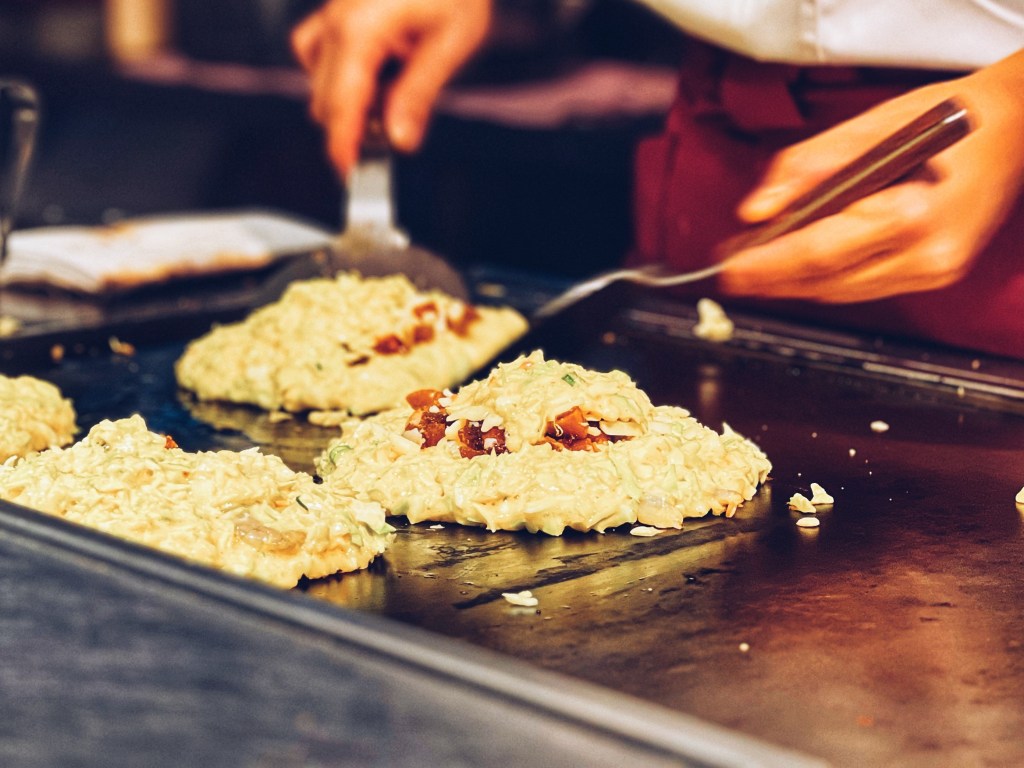
Just a few steps away from Bijou, Chibo stands prominently, its entryway buzzing with a small line of eager customers. I join the queue, and after only a short wait, I’m led inside and seated at the bar, where the cooks work with precision and speed. The open kitchen is a hive of activity, with flames blazing beneath sizzling pots, spatulas clattering against griddles, and steam rising from the batter as ingredients are carefully piled and cooked to perfection. Sometimes a chef will make a show of squirting mayonnaise onto batter. Watching these chefs skillfully make a variety of dishes is a captivating sight, as if witnessing a choreographed performance.
The place has a lively vibe and is filled with both locals and visitors. Although the entire menu is in Japanese, a helpful staff helps me by pointing out the choices. I keep it simple and go for the traditional okonomiyaki, a golden-crusted pancake stacked with fish, pork, and cabbage.


Moments later the plate arrives, and I’m faced with a heavy stack of fluffy batter topped with a glossy sauce, drizzled mayonnaise, and lots of bonito flakes. The umami-rich sauce and the subdued tang of the mayo accentuate the crunchy borders around soft, savory layers. Two or even three persons can eat this generous portion.
Having my fill of Osaka’s quintessential street foods, I walk out into the evening and the neon lights of Dotonbori once more brilliantly reflect the busy streets. Osaka is vibrant, with each alleyway and corner offering its own narrative.
Tonight, Osaka has given me a taste of its cuisine. And as much I want to explore more corners and flavors, my phone battery is slowly draining. Without Google Maps, I’ll lose my way back to the hotel, so I head to Namba Station for the subway ride back.
Directory
Bijou
Open daily from 12:30 p.m. – 10:30 p.m.
1-1-14 Dotonbori, Chuo Ward Okada Building B1F, Dotombori, Chuo, Osaka 542-0071 Osaka Prefecture
+81 9082208495
Chibo
Open daily from 11 a.m. to 11 p.m.
1-5-5 Chibo Dotonbori Bldg. 1F to 6F, Dotombori, Chuo, Osaka 542-0071 Osaka Prefecture
+81 662122211
Official Website
More from the Almost 40 in Japan Series
- Starting the Journey in Osaka
- Sampling Osaka’s Flavors in Dotonbori
- Navigating Kyoto’s Charms and Crowds
- Meeting a Geisha Up Close in Kyoto
- Savoring Kanazawa’s Edo Charm (and Gold Leaf Ice Cream)
- Letting It Go In Shirakawa-go’s Winter Wonderland
- Wandering Through Takayama’s Timeless Allure
- Witnessing a Shinhotaka Ropeway Virtual Whiteout
- Soaking In Hirayu Onsen’s Relaxing Waters
- Hello, Tokyo, Goodbye
 The Tourist Gaze