
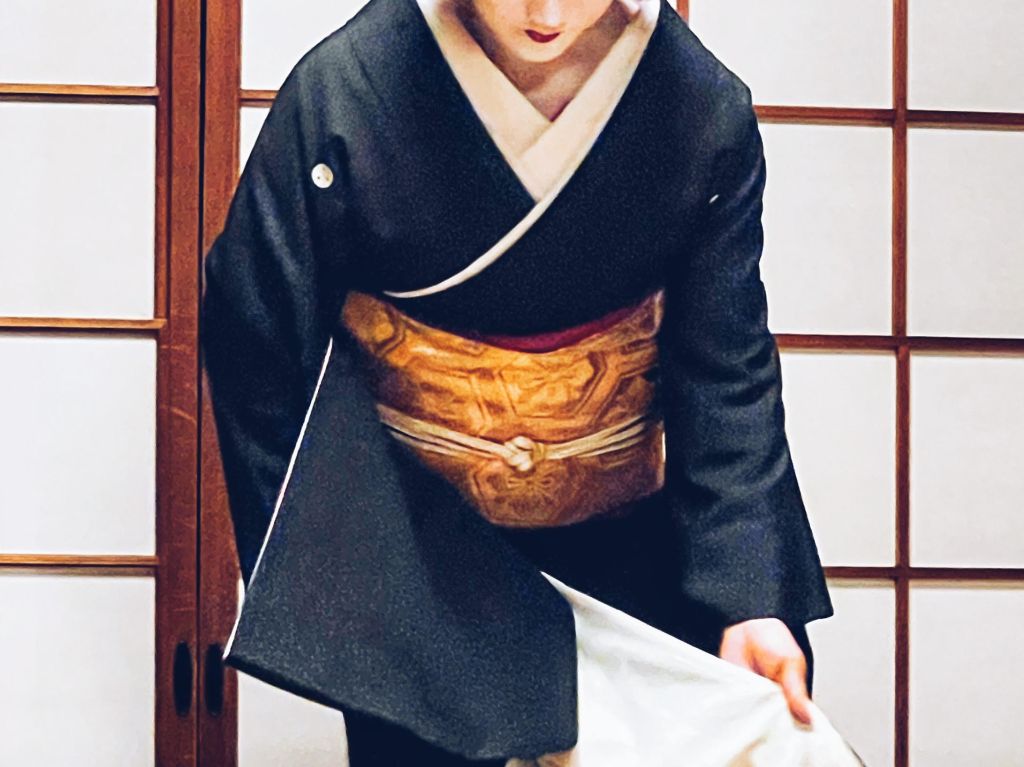
The sliding door slowly glides open, and Ayaka-san* steps gracefully into the room. Her presence immediately commands attention. Wearing a minimalistic black kimono and a golden obi, she dances with the grace that comes from years of practice. The distinctive white makeup covers her face, and the delicate curve of her scarlet lips harmonizes with the muted tones of her clothing. A quiet sense of wonder fills the room as she lowers her head in a profound bow.
The meeting with Ayaka-san is part of a tea ceremony session I had booked weeks before this trip. In recent years, there has been an increasing concern over the way tourists interact with geishas and maikos in areas like Kyoto’s Gion district. Although the geisha has a rich historical background, visitors sometimes approach these ladies as mere photography subjects without thinking through the cultural value of their look and job. Tensions in this delicate cultural setting have resulted from some visitors disturbing the daily activities of maikos (apprentice geishas) in an attempt to photograph or accost them in the street.

Arranging a tea session with a geisha or maiko guarantees that our group has an opportunity to interact in a manner that is controlled and civil. Through this, we avoid disrespecting their profession or disrupting their everyday activities; and as well, we learn about the history and significance behind the art of being a geisha or a maiko.
Although a session like this features a maiko, our group is lucky to meet Ayaka-san, a geisha, whose years of training and expertise enhance the experience to something even more remarkable.
Our host and interpreter opens the session by greeting us and giving a quick overview of the geisha tradition. The first geishas were men, known as taikomochi or hokan, who entertained guests with music, storytelling, and witty conversation. Over time, women began to take on the role, especially as the profession evolved to emphasize the refined arts of performance, hospitality, and engaging conversation. By the late 18th century, female geishas had become the predominant figures in the profession, overshadowing their male predecessors.

Usually starting in their early teens, maikos are young apprentice geishas. They get intense training in the fine arts of Japanese performance, including music, dance, and traditional tea ceremony. Their training also covers social skills development to enable visitors to be hosted in a way that combines grace, humor, and entertainment. Maikos become full-fledged geishas over time as they become experienced and proficient, and this usually comes with a change in their clothing and hairstyle.
The geisha profession is deeply embedded in Japanese history, with these women serving as cultural ambassadors of grace and artistry. While they can be found in several regions across Japan, particularly in areas known for their rich cultural heritage, they are often associated with Kyoto, where they are known as geikos. The distinct attire, the colorful kimonos, elaborate obis, and the unique hairstyles have come to symbolize the artistic traditions of Japan, and Kyoto especially.
The session continues with a question-and-answer segment, giving us a chance to engage directly with Ayaka-san. Emi facilitates the conversation, translating our questions and Ayaka-san’s responses.
Ayaka-san is first asked what made her want to become a geiko. She pauses for a moment, a thoughtful smile crossing her face, and then responds, “I have always been drawn to the arts. From a young age, I find joy in performing traditional dances and learning the intricate details of traditional music. Becoming a geiko feels like the natural path to immerse myself in these cultural expressions.”
But the path to becoming a geisha is fraught with challenges, as Ayaka-san shares with us about her own experiences. For one, geikos are deeply committed to their craft, spending years perfecting traditional arts like dance, music, and etiquette. Their lives revolve around performing at teahouses and entertaining guests, often requiring them to maintain strict schedules, staying up late into the night and waking early for training. When asked what the hardest part of being a geiko is, Ayaka-san takes a moment to reflect before answering quietly, “The hardest part is training the maikos, especially when they quit after some time.” She explains that many young apprentices enter the profession with high hopes, but the demanding nature of the work—long hours, intense learning, and strict discipline—can be overwhelming. When some maikos realize they can’t keep up, they decide to leave, which leaves Ayaka-san feeling a mix of frustration and sadness, as she invests so much time in nurturing their skills.

Another member of the group asks her whether being a geiko calls for a whole different way of life or if it’s like any other career where you can separate business from personal life. Her voice is thoughtful as she says, “Yes, the degree of commitment is very high, especially since you won’t be seeing your family much.” Her tone seems to be serious, and I wonder how she fits such a hectic existence.
Though the technique of becoming a geiko is sometimes misinterpreted or oversimplified, at its essence it is a real type of creativity and an expression of Japan itself—its history, its culture, and its own brand of hospitality. For women like Ayaka-san, who claims to have only three days off year, committing themselves to their trade is not a casual decision; rather, it is a life of discipline and sacrifice requiring a great degree of will.
Following the Q&A session, Ayaka-san stages a dance performance. While geikos have long been a representation of Japan’s rich culture, they are foremost entertainers, deftly combining dance, music, and art into a single experience. Their presentations show their technical ability as well as their ability to interact with the audience via grace and story. Every performance is firmly established in age-old customs passed down through generations, serving as both a personal expression and an artistic medium.
Ayaka-san moves slowly onto the tatami floor at first, her feet exact but fluid, her palms clutching two beautiful fans. Perfectly painted with complex designs, the fans flutter softly as they open and close in time with her motions. Her graceful and deliberate motions seem as though they are directly addressing our group and convey a subdued yet strong message. Seeing the artwork she brings to life as she masterfully blends her own unique flair with history is mesmerizing.

Following her performance, Ayaka-san leads us into the traditional tea-making ceremony, known as chanoyu, to showcase the delicate art of preparing matcha. Geikos frequently play an important role in the ceremony. More than just preparing tea, such ceremonies are a spiritual and contemplative activity founded on simplicity, harmony, respect, and purity. This centuries-old process requires painstaking attention to detail, from how the water is poured to the cautious handling of each item. It’s a moment of shared peace in which both the host and the guest meditate on the craftsmanship of tea-making.
During Ayaka-san’s tea-making ceremony, she glides gracefully about a small, low table, carefully preparing the appropriate tools: a delicate ceramic bowl, a bamboo whisk, and freshly ground matcha powder. She carefully pours hot water into the dish before adding the matcha, stirring it vigorously with a bamboo whisk while still maintaining a calm demeanor. She stops when the tea turns frothy, and then she delicately hands the bowl to Emi, presenting it with a small bow. The act’s simplicity and Ayaka-san’s quiet focus instill a respectful serenity, ever so subtly displaying a connection with this time-honored tradition.
After her demonstration, Ayaka-san bids us goodbye with a smile and a polite bow. She then walks softly toward the sliding doors, which Emi opens. She gives one last nod of thanks before disappearing behind the doors, leaving us grateful for the time she has so generously shared.
* Ayaka-san is a pseudonym, and I purposefully cropped the top half of her face in the pictures to honor her privacy and preserve the integrity of the cultural encounter.
More from the Almost 40 in Japan Series
- Starting the Journey in Osaka
- Sampling Osaka’s Flavors in Dotonbori
- Navigating Kyoto’s Charms and Crowds
- Meeting a Geisha Up Close in Kyoto
- Savoring Kanazawa’s Edo Charm (and Gold Leaf Ice Cream)
- Letting It Go In Shirakawa-go’s Winter Wonderland
- Wandering Through Takayama’s Timeless Allure
- Witnessing a Shinhotaka Ropeway Virtual Whiteout
- Soaking In Hirayu Onsen’s Relaxing Waters
- Hello, Tokyo, Goodbye
 The Tourist Gaze