
Kanazawa Station: A Sleek Arrival

Picturesque traditional teahouses, serene gardens, and remnants of Edo Period charm. You would think that I’m still in Kyoto, ready to uncover more of its treasures. But no, I’ve left the city at dawn and have just arrived in my next destination: Kanazawa, the capital of Ishikawa Prefecture.
From its founding in 1583 to the present day, Kanazawa has been steeped in history. The city and the Maeda Clan that governed it experienced enormous wealth during the Edo Period, which let Kanazawa grow into a treasure trove of traditional architecture, workmanship, and art. This got it the moniker “Little Kyoto” as it so closely resembled the previous imperial city. In fact, in its heyday, Kanazawa competed with Kyoto in cultural sophistication and artistic excellence, becoming a hub for ancient crafts such gold leaf manufacture, Kutani porcelain, and delicate silk dyeing. Still, it kept its distinctiveness apart from Kyoto. Tucked close to the base of the Japanese Alps and acting as a critical link between the mountainous areas and Kyoto’s cultural core, Kanazawa was able to create a special fusion of influences.
Early popularity of Kanazawa was not its only lucky stroke. Unlike many cities devastated by World War II, Kanazawa came out mainly unharmed and kept its abundance of cultural and historical relics intact. Testaments to its ongoing history are its whole samurai districts, teahouses, and painstakingly kept gardens. Geographical serendipity combined with historical persistence has molded Kanazawa into a city where the past is still alive, allowing tourists to see traditional Japan in a more calm contrast to Kyoto’s bustling vibes.
The train rolls into Kanazawa Station, a sleek, modern spot that gives off a contemporary energy. As I step out of the station, luggage in tow, I immediately see a striking juxtaposition of heritage and modernism as two great structures spanning the past and the present appear before me. The first is the architectural marvel known as Tsuzumi-mon Gate, which mimics traditional Japanese hand drums with its strong oak beams softly arching upward. Looming behind it is the Motenashi Dome, a sweeping glass and steel dome that glistens in the early light.
I’m even more surprised by the cityscape as I cross the highway. Contrary to the nostalgic charm I expected, the streets from the station are spacious, tidy, and throbbing with a clearly modern pulse: wide highways, skyscrapers, and commercial hubs quietly catering to those escaping the cold. I walk to my hotel, which is just a few minutes from the station. I arrive too early to check in, but the courteous staff nevertheless collects my luggage so that I can freely explore the city.
Omicho Market: Fresh Catch Galore

From the hotel, I head to Omicho Market, the hive of gastronomy for Kanazawa. The historic market provides a glimpse into local culture, particularly the region’s seafood. It is also known as the “Kitchen of Kanazawa” since it is where locals go to buy fresh produce, fish, and other food items. The market was established in the 18th century and has been an important element of the city’s life for generations. Today, it remains one of the greatest spots to enjoy Kanazawa’s food scene.
I wander around the narrow lanes and stalls, taking in the sight and smell of fresh fish fill the air. Omicho Market is well-known for its fresh seafood, with sellers selling a wide range of fish, shellfish, and seaweed, including the legendary Kanazawa crab, with their long legs extending out so dramatically. While some are orderly bound, others lie on smashed ice, their vivid red shells sparkling like they’re recently taken from the sea.
Aside from shellfish, there are many more local delicacies, including vegetables, pickles, and sweets. There are also prepared dishes such as sushi, sashimi, and other street food delicacies—ideal for a quick snack or lunch on the fly.
Higashi Chaya: Old-School Teahouses and Gold Leaf Ice Cream


I head next to Higashi Chaya, a district that seems to have been stuck in time. Traditional wooden machiya dwellings, with their beautiful latticework and lamps on their frontages, line the little streets. With many stores closed for early morning, the area seems silent and peaceful. Apart from me and a few other visitors, the place seems to be virtually deserted, as if the district is waiting to come alive later in the day. Still, here is the Kanazawa I imagined—a site where the spirit of old Japan still shines and every inch shows Edo-era grandeur.
As I explore, the sky darkens and tiny ice pellets start to fall—sleet, I realize. I seek cover under the eaves of a closed store and wait for the weather to improve before resuming. The rain finally softens enough for me to keep walking, but as it intensifies again, I quickly hide in another store where I discover something I’ve been intrigued to try: gold leaf ice cream.
One of Kanazawa’s most well-known exports is gold leaf, painstakingly created by expert craftspeople from pure gold. Famed for its gold leaf output, Kanazawa has a history going back to the 17th century when the Maeda clan, in charge of the region, promoted its use in many industries. Everything from lacquerware to sweets is covered in the thin gold sheets, so fragile they glitter under the light. And today they have crept into this delicious dessert.
Indulging in a luxurious gold leaf ice cream may sound touristy, but it is nevertheless a quintessential Kanazawa experience. The soft-serve ice cream is covered in edible gold leaf, which while not adding much to the flavor, gives it its visually opulent appearance. Furthermore, it emphasizes Kanazawa’s prestigious background of gold leaf workmanship.
I take my time in relishing my ice cream. When I’m done and the rain stops, I exit the store and continue my sightseeing tour.
Kanazawa Castle and Kenroku-en: Exploring a Reborn Fortress and a Serene Garden


I head next for Kanazawa Castle. The streets leading to it are quiet, with just the occasional cars and the sound of footsteps on wet ground. Only a few visitors like me are walking about. I decide not to pay the additional fee to tour the interior, instead opting to simply explore the castle grounds. The scene is a mix of well-kept gardens, damp walkways, and seemingly limitless ancient stone walls. Every now and then I feel the odd splash of sleet as it falls—fast, light bursts of cold rain, wetting the earth beneath my feet.
It’s becoming a theme now, but my feet are starting to get sore again, so I enter the castle’s rest area to sit down for a few minutes. A big glass window provides a beautiful picture of the castle, almost like a wide-screen display, the gentle glow of subdued light reflecting off the moist surroundings.
Long a symbol of Kanazawa’s rich legacy, Kanazawa Castle was built during the Edo period in the early 17th century. The castle served as the Maeda Clan’s seat of authority over Kanazawa for centuries. Though largely rebuilt following its collapse in the late 1800s, the castle itself still bears traces of its past grandeur—the stone walls, moats, and imposing gates suggest its strategic relevance. It is surrounded by verdant gardens, which I imagine to be more vividly colorful in spring blossom. In the winter, with snow yet to arrive, the wet ground and overcast sky give the surrounds a desaturated gloomy look.
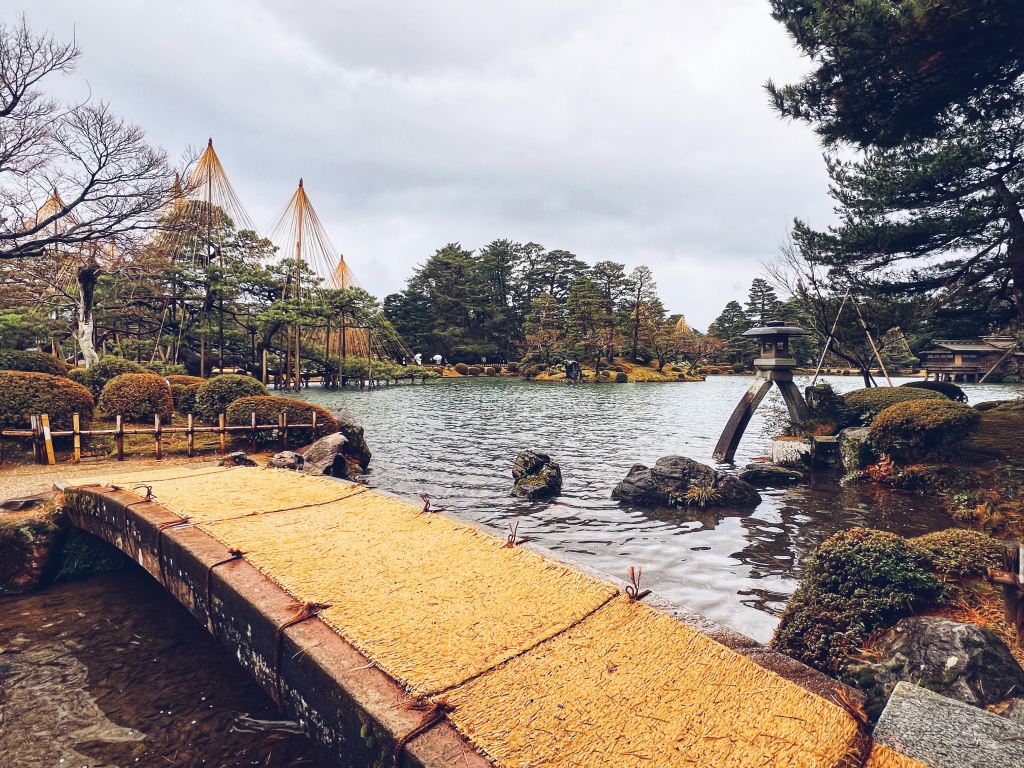
I next head across the highway into one of the most well-known landscape gardens in Japan, Kenroku-en Garden. Designed during the Edo period, this one of the “Three Great Gardens” of Japan was intended for the Maeda family in power to unwind and appreciate the surroundings. Covering more than 11 hectares, it boasts winding paths, immaculate ponds, well placed boulders, and precisely trimmed trees reflecting classic Japanese design. This is where human creativity and environment coexist peacefully and tranquilly is created.
When I get there, I approach the ticket booth and a friendly woman smiles at me. She asks where I am from.
“The Philippines,” I say.
“Welcome to Kanazawa! I hope you enjoy the garden.”
She then hands me a ticket and I walk in.
And enjoy the garden I do, even as the wind picks up. I shiver despite the three layers of clothing under my bubble jacket.
Kenroku-en dates back to the early 17th century and was developed by the Maeda family over several generations. The name “Kenroku-en” means “garden of six sublimities,” referring to the six essential qualities that make a garden perfect: spaciousness, seclusion, artificiality, antiquity, watercourses, and panoramas.
The sprawling garden is filled with lush greenery, ponds, streams, waterfalls, and paths that create a peaceful, harmonious atmosphere. It’s designed in a strolling garden style, where visitors can enjoy different scenic views from various angles as they walk through it. The garden is said to be a great place to visit all year long, as its takes on different forms of beauty whatever the season.
Today, even with the dark sky and the bare limbs of some trees, the garden is undeniably lovely. The soft tones of gray and green blend together to create something peacefully sublime. But I can only imagine how much more enchanting this place must be when the snow blankets the paths and creates a serene, almost otherworldly atmosphere. That must be magical.
Today, I content myself with this version of the garden’s image: stone lanterns standing quietly along the dampened earth, while patches of green grass peek through the patches of melting frost. The water in the pond sits still, dark and calm, with koi swimming beneath its surface. As I stroll deeper into the garden, I’m amazed by how well the natural elements and the carefully crafted design work together. Even under the muted light of the cloudy sky, Kenroku-en retains its timeless beauty regardless of the season.
Modern Sensibilities: Visiting the 21st Century Museum of Contemporary Art

I exit the garden’s southern gate and head to the 21st Century Museum of Contemporary Art. Established in 2004, the museum has quickly become an important part of Kanazawa’s cultural landscape. It stands as a testament to the city’s commitment to preserving its Edo-era heritage while also promoting contemporary art. As a city long recognized for its craftsmanship and artistic excellence, Kanazawa continues this legacy in the modern times by merging traditional influences with avant-garde creativity.
But what I was really looking forward to was seeing the famous Swimming Pool installation by Argentine artist Leandro Erlich. Unfortunately, I learn that it requires advance registration, something I hadn’t planned for. Instead, I take an extended rest on one of the couches in the spacious lobby, content to admire the museum’s modern architecture. With its clean lines and open design, the museum stands in contrast to the traditional charm of Kenroku-en, yet blends seamlessly with Kanazawa’s expert balance of rich history and forward-thinking innovation.
Nagamachi: Peeking at Former Samurai Houses


Half an hour later, I resume my walk. The weather starts to clear up as I get to Nagamachi—it’s a nice chill, bearable, cloudy afternoon with some sunny moments thrown in. The rain has mostly stopped, and the streets are feeling all fresh and welcoming now.
Nagamachi, steeped in the city’s samurai history, is one of Kanazawa’s treasured spots. Originally the homes of lower-ranking samurai, this area provides an intriguing window into the Edo period when Kanazawa prospered under Maeda clan control. Surrounded by earthen walls, the narrow, cobblestone streets dotted with traditional wooden houses create a sense of timelessness that allows guests to see daily life of the samurai class. Many of these houses have been carefully preserved, and some now serve as museums, allowing visitors to step back in time and explore the rich cultural heritage that shaped Kanazawa’s identity.
I catch glimpses of the well-maintained samurai homes as I explore the small side streets. One notable house is the Nomurake Samurai Residence, the former abode of a family who held top posts under the Maeda rule. The house has a coffered ceiling made of Japanese cypress and traditional paintings on sliding-door panels. The garden inside the compound features a more than 400-year-old Japanese bayberry and a stream ringed by ancient rocks.
Another site of note is the Kanazawa Ashigaru Museum, which features the Takanishi and Shimizu Family Houses, two ashigaru houses. Ashigaru were feudal Japanese foot troops. They formed battalions of archers and gunmen during the Sengoku (“Warring States”) and Momoyama periods from 1467 to 1600, but in the Edo period (1603–1867), they were the lowest rank of samurai in the Kaga domain (feudal-era Ishikawa centered on Kanazawa). Akigaru organizations, life, residential regions, and housing are explained at the Takanishi Family House; the neighboring Shimizu Family House shows their daily life.
I move across the district leisurely, soaking in as much of the historical vibe as I can. My walk ends with a sign that catches my attention: “Want to try Kanazawa-style hot dog?” Yessir, I do.
I follow the arrow, leading me to Street Vendor, a little, understated store hidden from the main road. The interiors are decorated with what I assume are souvenirs of the owner from abroad. The radio in the kitchen is airing an FM station from Hawaii. I order the Kanazawa-style hotdog that the sign teased me with, and in the menu it’s called Old School Dog. Minutes later, the owner who is also the cook, presents me with a hot dog topped with curry-seasoned cabbage slaw. Unique in flavor, savory with a twist, the dish perfectly caps off my exploration of this charming district. The friendly owner even surprises me with a free chocolate coin as I am leaving.
Korinbu: Back to Modern Times with a Book and a Cup of Tea

I return to the main highway, where contemporary buildings replace the old houses to serve as a reminder that this is 2025 (the year that, yeah, I am turning 40). The city’s skyline is peppered with glass and steel structures, and the buzz of the modern world hums alongside the timeless allure of its historic streets. Though the contrast is striking, it feels as though Kanazawa’s past and present naturally blend with each other.
I enter a small modern cafe, whose simple design and soft lighting create the perfect haven from the frigid weather. I tuck myself into a corner and open a Japanese murder mystery book to read with a hot cup of matcha latte. But with exhaustion setting in, my eyes flutter shut on every other paragraph, and I find it difficult to concentrate. Finally I give up. I finish my latte, pack my stuff, and get on the bus to return to the train station. The trip is surprisingly quiet even though it is rush hour and the bus is packed. The streets pass by in a swirl of city lights and commuters.
Once I get to the station, I walk back to the hotel and officially check in. The soft buzz of the city fades behind me as I prep myself for a much-needed downtime.
Kanazawa Travel Basics
Timing
- Kanazawa is a year-round destination, but each season offers something special. Spring (March–April) brings cherry blossoms to Kenroku-en.
- Autumn (October–November) paints the city in vibrant red and gold hues.
- Winter (December–February) is magical with snowy landscapes and the famous yukitsuri ropes protecting Kenroku-en’s trees.
- No matter the season, don’t miss trying the gold leaf ice cream, available all year
Access
- From Kyoto: Several options can take you from Kyoto to Kanazawa. The quickest is to take a Thunderbird train from Kyoto Station to Tsuruga Station, and then transfer to the Hokuriku Shinkansen bound for Toyama, which stops at Kanazawa. The whole trip costs JPY 7,720 and takes around 2 hours.
- From Tokyo: Take the Hokuriku Shinkansen in Tokyo Station, which costs JPY 14,380 and takes about 2 hours and 30 minutes.
Transportation
- Kanazawa’s public transportation system is convenient, with buses and taxis readily available around the city. The Kanazawa Loop Bus (JPY 800 for a one-day pass; cashless transactions only) offers easy access to main attractions and is affordable for tourists.
Accommodation
- SHARIN is a budget-friendly option about a 15-minute walk from the station. Approximately JPY 4,500 per night for a dorm bed; private rooms available at higher rates.
- HOTEL AMANEK Kanazawa provides comfortable amenities near the Nagamachi District. Approximately JPY 10,000 to 15,000 per night, depending on room type and season.
- Hotel Nikko Kanazawa has beautiful views and premium services in the heart of the city. From JPY 12,000 per night, higher for suites or during peak seasons.
Food
- Kanazawa is famous for its gold leaf ice cream, available at many stores especially in the Higashi Chaya District. One of the top places to sample this is Hakuichi, a distinguished gold leaf shop in Kanazawa also known for its premium gold-covered soft-serve ice cream.
- Street Vendor is a homey place in the Nagamachi District to try Kanazawa-style hotdog (hotdog topped with Kanazawa-style curry and cabbage slaw).
- Aburaya, a noodle place near Omicho Market, serves Kanazawa-style aburasoba (soupless oiled ramen).
For more practical information, visit Kanazawa Tourism Official Website.
More from the Almost 40 in Japan Series
- Starting the Journey in Osaka
- Sampling Osaka’s Flavors in Dotonbori
- Navigating Kyoto’s Charms and Crowds
- Meeting a Geisha Up Close in Kyoto
- Savoring Kanazawa’s Edo Charm (and Gold Leaf Ice Cream)
- Letting It Go In Shirakawa-go’s Winter Wonderland
- Wandering Through Takayama’s Timeless Allure
- Witnessing a Shinhotaka Ropeway Virtual Whiteout
- Soaking In Hirayu Onsen’s Relaxing Waters
- Hello, Tokyo, Goodbye
 The Tourist Gaze