
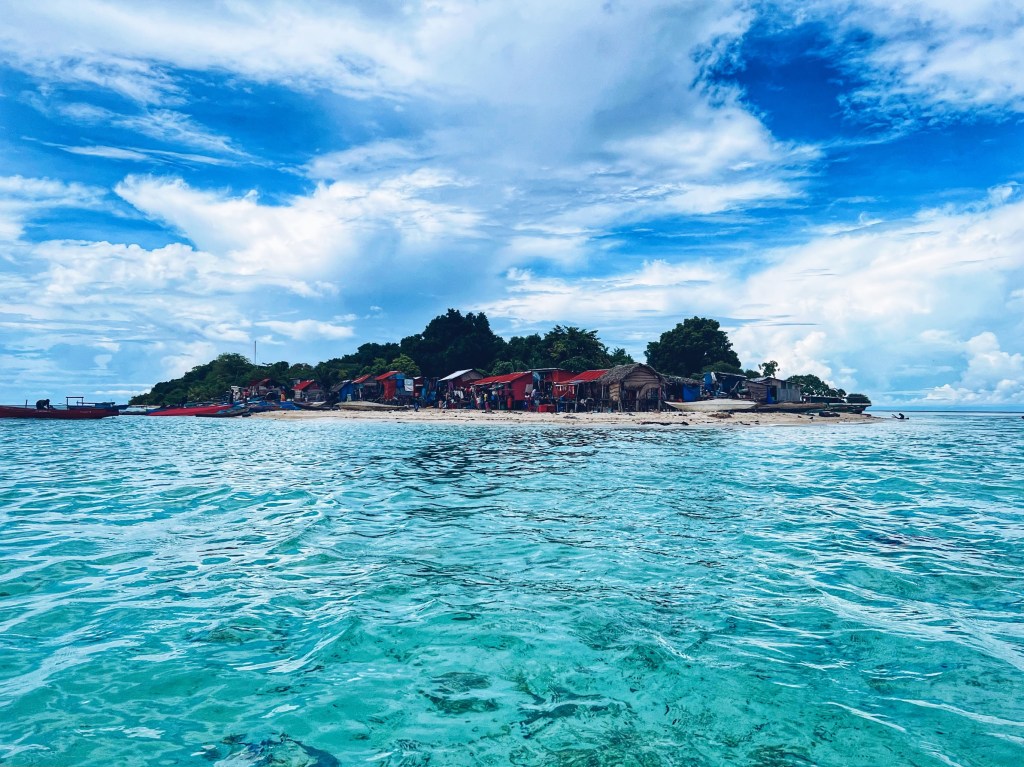
When our boat curves around the shallows of Panguan Island, the first thing I notice isn’t the sand or sea. Rather, it’s movement: children running toward the shore as we approach, laughing and shouting as the wind blows lightly. They wave enthusiastically, kicking up sprays of saltwater as they chase our boat along the coastline. They stop a few meters short of where we dock. Even before we step onto land, the island has already greeted us.
When we finally anchor and set foot on the beach, a pack of dogs trots toward us, tails wagging. “For some reason, the dogs know who the guests are and welcome them,” our Sitangkai guide, Agih Eppih Mohammed, remarks with a smile. “If they sense that a boat carries people with bad intentions, they bark. But they know you’re friendly visitors, so they’re happy to see you.”
The air is heavy with sea salt and sunlight. The beach shimmers pale and powdery white, and from every direction, soft waves lap against the island’s perimeter. The atmosphere is subdued but feels alive, with an undercurrent of energy not unlike the border it guards.


I’d come here with my group tour, an excursion that began in Bongao and wound its way southward to Sitangkai. Panguan Island, part of Sitangkai municipality, is more than just a speck of land, though: it’s the last Philippine island before the maritime border with Malaysia. On a clear day, Mataking Island of Malaysia is visible just across the water, and on the horizon, the faint outline of Sabah seems as if it’s daring us to push past the border and chase it.
Even before we set sail from Sitangkai’s main village on a boat with no roof (prompting me to improvise a head wrap out of a spare shirt and a towel loaned by a fellow traveler) I’d picked up snippets of the island’s history. While waiting for our fast craft in Bongao, an elderly man named Andrew De Vergara had approached our group. A retired surgeon originally from Bicol, he had spent decades in Tawi-Tawi, leading medical missions and helping make healthcare accessible in the province. He spoke animatedly about Panguan’s past, sharing how the island once had a school sustained by volunteer teachers. When those volunteers could no longer stay, the school shuttered, and now, children make a one-hour boat ride to Sitangkai proper during the week to attend school, returning to Panguan only on weekends.
Indeed, despite its remoteness, Panguan has a thriving community. There’s no visible military presence (though there is a navy quarters somewhere on the island) and where we docked stands a modest concrete marker declaring: “Municipality of Sitangkai, Province of Tawi-Tawi, Philippines.” As Agih shows Joy and me around, we encounter children playing on the beach, leaping off driftwood logs into the ocean, their laughter mingling with the waves. An elderly woman sits weaving a banig mat in the shade of her hut. Young women pass by with burak (a paste of turmeric and rice) spread across their cheeks, a natural sunblock reminiscent of Myanmar’s thanaka.


We pause at a small sari-sari store where Agih buys us Malaysian snacks. Given how much closer Sabah is than even Mindanao, the stores here naturally stock Malaysian goods. It reminds us of just how porous these maritime frontiers are. For the Tausug and Sama people especially here, borders mean less than kinship, trade, and shared seas.
Standing on Panguan Island, I feel a kind of pride that comes from reaching a frontier, about as far south as I could go in my own country without crossing into another nation. Looking out toward the maritime horizon, I feel some sort of reaffirmation. At this point in life, to still be chasing edges, seeking places as far-flung as this, you realize you’re never really quite there. There’s always another horizon to cross, another shore to reach.
Yet as much as I cherish the discovery of distant horizons, it’s the moments spent at the edges, with new experiences but also the familiarity of the people around you, that truly connect you.
Before leaving, Agih takes the rest of the group for a walk through the community as well. While waiting for them, I dip my feet in the water, not wanting to rush our last moments here.


But leave we must eventually. On the way back, we make a stop at Mardanas Island. Once a strategic naval outpost, the navy has since moved to Panguan, leaving the island’s peaceful shores with its military past now only visible through the weathered concrete structures.
Here, we have lunch on the beach—fish, chicken, rice, and Malaysian-style noodles, all packed in Orocans and spread out over a large cloth on the sand. After eating, we lounge in the shade of a ruined concrete walkway, chatting and taking photos, letting the early afternoon stretch in the heat.
Our final stop is Bulu-Bulu. Like a tranquil retreat, the island’s powdery shores and gentle waves provide a relaxing place to unwind. The calm atmosphere makes it an ideal spot to slow down after a day of exploration. Our energy is beginning to dip by this time, so most of us sit quietly by the shore, too tired to do much else. Conversations drift easily, the way they tend to after a long, sun-drenched day of new places and shared discoveries.
By the time we make our way back to Sitangkai’s stilted homes and narrow waterways, the golden hour has begun to cast its light across the sea. The day feels full. In this corner of the Philippines, where borders blur in the midst of shared cultures and histories, I find that what stays with me isn’t just the remoteness of the place, but the people who live and endure here. At the edge of the map, there is still so much life.
Life that is sun-warmed, salt-streaked, and silently resilient.
Panguan Island Travel Basics
Timing
- The best time to visit Panguan Island is during the dry season (March to May) when seas are generally calmer and skies are clearer.
- Avoid the southwest monsoon months (June to September) as waters can be rough and weather unpredictable.
- Since this is a border area, it’s also best to monitor local security updates and coordinate with local guides or authorities before your trip.
Access
- Getting to Panguan Island is only possible from Sitangkai. From Zamboanga City, fly to Bongao, Tawi-Tawi. Take a fast craft from Bongao to Sitangkai (PHP 1,000, around 1 hour). Arrange a local boat from Sitangkai proper to Panguan Island (PHP 13,000 for 4 people, around 1 hour).
- Tours to Panguan Island often include stops at Mardanas Island and Bulu-Bulu Island on the return trip to Sitangkai.
- It’s best to coordinate with a local guide in Sitangkai for permits, boat arrangement, and smoother travel. Our tour was organized by Layag Tawi-Tawi Tours, which also does other tours in the province, such as Bongao town tour and Sitangkai tour.
Essentials
- Hat, sunglasses, sunscreen, scarf or towel for shade (Boats in Sitangkai have no roofs, so long-sleeved shirts or rash guards are recommended.)
- Drinking water and snacks (limited stores on the island)
- Cash (no mobile payments accepted; carry small denominations and coins)
- Dry bag for your phone and gadgets
- Basic first aid kit (especially for sunburn and heat-related issues)
More from the Tawi-Tawi: Stillness at the Southern Edge series
- Bongao, Tawi-Tawi: Exploring the Gateway to the Philippines’ Southernmost Frontier
- Bud Bongao: We Conquered the Highest Peak of Tawi-Tawi and Here’s What It Taught Me
- Island Hopping from Bongao, Tawi-Tawi: Panampangan, Simunul, and Sangay Siapo
- Sitangkai, Tawi-Tawi: Life in the “Venice of the South” Isn’t What You Might Imagine
- Panguan Island, Tawi-Tawi: We Reached the Edge of the Philippines and Were Surprised by What We Found
 The Tourist Gaze