
After my personal project in Sariaya, I am craving for another road trip to Quezon. I mention it to my mom, and perhaps it’s the boredom from staying too long at home, because she wants to go too. Since it’s our school’s academic break (or “wellness break,” as the government calls it), I agree to the trip. We used to do these often during the pandemic, but stopped on a regular basis once life returned to normal.
With my sister on vacation abroad and my brother in Canada, it’s just Mom, Dad, me, Ate Lita, Rona, and two pastors, Pastor Borj and Pastor Adrian. Ate Lita and Rona help care for Mom, while the pastors are two of the three Gen Z ministers of our church (Pastor Gwen can’t join today because of the flu).
Dad initially suggests Lucena, drawn by some of its restaurants, but I recommend Tayabas so we can revisit a town we’ve only lightly touched before. Almost four years ago, we briefly passed through the city on a road trip, stopping only for lunch before heading home from Lucena. This time, we plan to explore it properly.
Mom’s First Road Trip After Surgery

It’s been a little over a month since Mom underwent cataract surgery. At first, she was restless, confined mostly to bed, and even developed a stiff neck, the first time she said she experienced such pain. She now wears protective goggles, and we carefully monitor her every move.
Prior to the surgery, we hadn’t realized how bad her eyes were. She rarely mentioned her vision problems, but she was quietly struggling to see. Only after an eye injury brought her to the doctor did we learn the full extent: that she had cataracts in both eyes and was in urgent need for surgery to prevent total blindness. Complicating matters, her left eye was permanently damaged due to nerve issues, leaving her dependent entirely on her right eye.
Seeing her now is a relief. Prior to the surgery, when the doctor warned that there was a 50–50 chance of losing sight in both eyes, we were overwhelmed with worry and sympathy. Now, even with only one functioning eye, her joy has returned. It’s subtle yet unmistakable, providing a spark of freedom and confidence we haven’t seen in months.
This Tayabas trip is her first proper road trip since the surgery. Although she has traveled before with a short excursion to Tagaytay with women from church, this is the first journey devoted entirely to sightseeing and enjoying meals together.
Lunch at Rodillas

After a long drive made lengthier by heavy traffic in San Pablo, we finally reach Tayabas at noon. Our first stop, of course, is somewhere we can have lunch. The easy choice is Rodillas, a local favorite for Filipino comfort food. The restaurant began in 2010 with Juliet and Vincent Rodillas, when they first sold their softly‑frosted yema cakes locally. By 2014, a factory was established in the city and the business grew into one of Quezon’s iconic souvenir makers.
We also dined here on our first Tayabas trip in 2022. And as with then, the restaurant retains a simple, unpretentious interior, with wooden tables and bright posters showcasing their bestsellers. What stands out immediately is the bevy of pasalubongs and dishes displayed at the counter like a turo-turo. The atmosphere is casual, which makes it a great stop to rest after the drive.
Each member of our road trip takes turns ordering, choosing dishes of the day like pinangat, Bicol express, and dinuguan. Of course, I can’t resist going for pancit habhab and Lucban longganisa since we’re in Quezon. And naturally, we have yema cake to finish. The portions are generous, so we share everything, passing plates around and savoring a little bit of everything together.
Tayabas Historical Center: Rizal Park, Casa Comunidad, and Minor Basilica


After lunch at Rodillas, Ate Lita, Rona, and I stroll through Tayabas’ town center, letting the afternoon sun and cool amihan breeze guide our way. The rest of the group stays behind to rest, planning to meet us later at the church. As we walk, the city’s green spaces, colonial-era streets, and well-preserved architecture provide the perfect backdrop for an impromptu photoshoot.
Tayabas, founded in 1591 as Visita de Tayabas, is one of Quezon’s oldest towns. Its streets and houses witness centuries of history—first as thriving coconut plantations during Spanish colonial governance, and then later as a venue of local resistance during the Philippine Revolution. Today, the town’s cobblestone walkways, ancestral houses, and public spaces preserve that legacy, giving visitors a sense of walking through a living museum.
We pass through Rizal Park, noting its monuments and open green areas, before arriving at Casa Comunidad de Tayabas, a colonial-era building that once serves as a government seat. Its Spanish-inspired architecture, wide verandas, and intricate wooden details speak of a bygone era. We stop for a bit here, using the structure’s thick walls and a cannon replica as props for our photoshoot.
Our walk ends at the Minor Basilica and Parish of St. Michael the Archangel, where the church’s centuries-old stone façade and ornate interiors offer a quiet contrast to the bustling town streets.
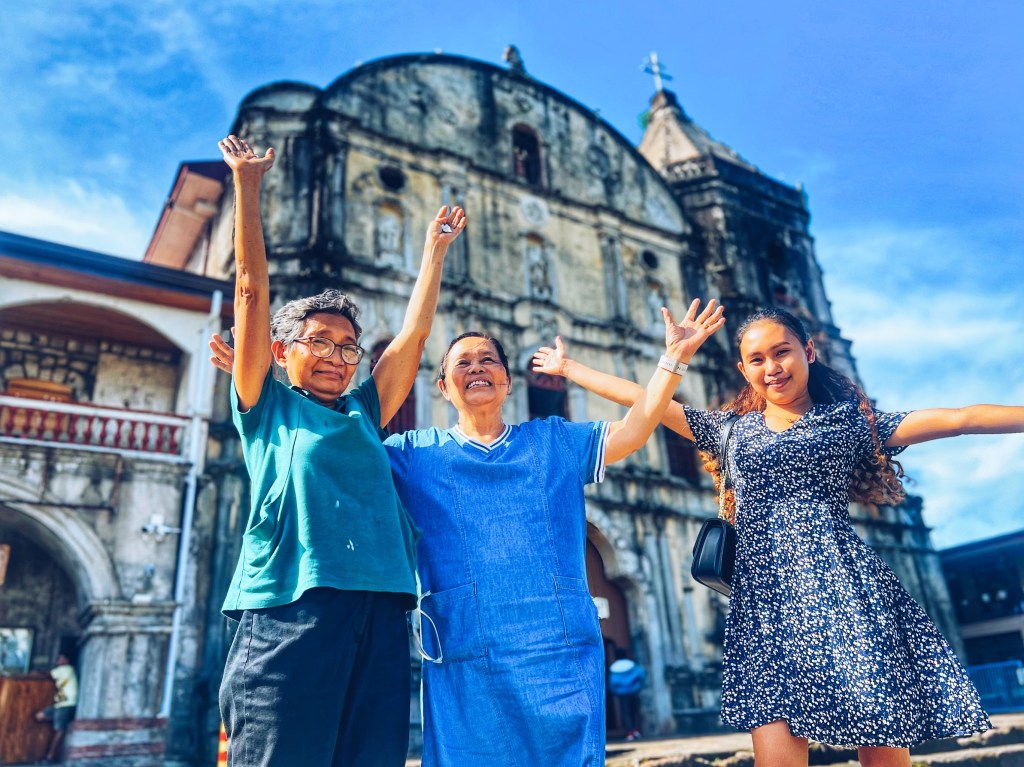
A few minutes later, the rest of the group arrives. Mom carefully steps down from the car, leaning on her cane, and her face lights up as she takes in the façade of the centuries-old church. With Rona and Ate Lita guiding her gently, she positions herself for a photoshoot in front of the basilica.
There’s radiance in her expression, showing a mix of awe and gratitude. Even with sight restored in only one eye, she beams as if seeing the world anew. The intricate stone carvings, the towering bell tower, and the sun streaming over the church steps all seem to delight her senses. She laughs freely, sharing little observations about the details she notices for the first time in months—maybe even years (who knows how long she kept her eye problems to herself?).
In these moments, she doesn’t say it, but her happiness feels palpable in the way she looks upward and smiles with gratitude. The basilica, a place of centuries of devotion, reflects her faith and grace. My mom’s joy isn’t just about sightseeing, but about reclaiming a sense of freedom and wonder after the months of limitation. Even partial sight can illuminate the heart.
Puente de Malagonlong: A Timeless Spanish-Era Bridge


Our final stop is the Puente de Malagonlong, a historic Spanish-era bridge spanning the Tayabas River. Built in 1841 during the Spanish colonial period, it was commissioned by Gobernadorcillo Don Joaquin Ortega as part of the town’s infrastructure to facilitate the transport of agricultural goods, particularly coconuts and other plantation products, to the town center. Constructed entirely of adobe stones, lime, and clay, the bridge exemplifies the ingenuity of local builders in adapting European engineering techniques to the Philippine context. Its enduring arches and solid masonry have allowed it to withstand centuries of weather and river currents, making it one of the longest and oldest Spanish-era bridges in the country.
Today, Puente de Malagonlong serves not only as a functional bridge but also as a cultural landmark. It remains largely preserved in its original form, attracting tourists, many of whom are students and history enthusiasts who come to admire its craftsmanship and historical significance. Walking across the bridge, visitors get a sense of the slow, deliberate pace of life in 19th-century Tayabas, as well as the continuity of community life that has passed over its stones for generations. The bridge’s rustic charm and serene riverside setting make it a poignant stop on any heritage tour of the town.
Mom doesn’t go the full length, as without her wheelchair, long distance walks are difficult. Instead, she sits comfortably at the edge of the bridge while we explore. She chats with a local tourism officer, soaking in stories of the bridge’s past. The officer jokes, “This bridge is more durable than anything built by the DPWH.” It’s funny, but it’s also hard not to agree.
Meanwhile, the rest of us wander, take photos, and marvel at the structure’s enduring beauty. For Mom, even these brief moments of engagement are precious: the joy of being outside, surrounded by history and loved ones.

The golden hour is at its most romantic as we leave Puente de Malagonlong. We pile back into the car, filled with a sense of accomplishment and gratitude. Before heading home, we plan a stop at SM Lucena for dinner before the long drive back. Even in the familiar trappings of a mall, a sense of celebration permeates in recognizing the resilience and of life moving forward despite setbacks.
It’s moments like this that make me realize how precious these small joys are. For my mom, it’s the simple act of seeing, of walking, and of being somewhere together. After weeks of recovery, it feels like she’s reclaiming pieces of her independence and delight in the world again.
As the road stretches ahead, I think of the day’s small adventures: the lunch at Rodillas, the colonial streets of Tayabas, the grandeur of its basilica, and the enduring strength of Malagonlong Bridge. In the middle of all these is my mother, savoring every moment. Road trips like this are often more about the moments and the people we share them with. And today, for all of us, it’s a reminder that love and joy don’t require perfect vision—they only need to be felt deeply.
Tayabas Travel Basics
Timing
- Tayabas is best visited during the dry season, from December to May, when the streets and heritage sites are easy to explore.
- Visiting outside local festivals ensures a quieter experience, though travelers may also plan around nearby Lucban’s colorful Pahiyas Festival held every May 15 for a joyful cultural experience.
Access
- By car: Tayabas is roughly 3–4 hours from Manila, depending on traffic. If driving, take SLEX (South Luzon Expressway) and continue via the Quezon Eco-Tourism Road or the Maharlika Highway (AH26). A private car gives you flexibility to explore heritage sites at your own pace and is ideal if traveling with family or elderly companions, as in our road trip.
- By bus:
- From Metro Manila, the most convenient way is by bus to Lucena City Grand Terminal. Buses depart from several terminals, including JAM or JAC in Kamias, DLTB along EDSA, or Araneta Busport for daytime trips. One-way fare costs around PHP 200 – 350, depending on terminal and bus type.
- From Lucena, you can take a jeepney heading to Tayabas or nearby Lucban, then hop off at the town proper near Gulang-Gulang/Diversion Road. A jeepney ride from Lucena to Tayabas costs around PHP 30 – 50 per person.
Transportation
- Tricycles are available from anywhere in Tayabas city center to major landmarks like the plaza, the Minor Basilica, or Casa Comunidad. A trip within the city costs around PHP 20 – 50, depending on distance.
- A trip to Puente de Malagonlong takes about 10–15 minutes by tricycle or private car. One-way tricycle fare is roughly PHP 50 – 80.
Food
- Tayabas offers a mix of heritage and culinary delights, which makes it a great spot for a food-focused trip. Rodillas is an institution best known for its yema cake, which is large enough to share with friends or family (with some left for the ride back home).
- Cornelia’s Plate and Liwag’s Pansit Hab-hab are local favorites, both offering authentic, home-style Quezon cuisine that highlights regional specialties. Note that the latter doesn’t have dine-in facilities.
- Slightly outside the town center, Ninong’s Restaurant provides hearty meals in a spacious, family-friendly setting.
- There’s also a local branch of Buddy’s, a Quezon favorite from Lucban, serving classic Quezon dishes like pancit habhab and Lucban longganisa, as well as other Filipino favorites.
Accommodation
- Accommodation options in Tayabas are limited but charming. The Legacy Hotel offers modern amenities and comfortable rooms right in the heart of the town, making it convenient for exploring the heritage streets and nearby attractions.
- Piscana Resort provides a more relaxed, resort-style stay surrounded by greenery. It’s ideal if you’re seeking quiet and comfort.
- If you’re willing to commute or drive back, Lucena City has a wider range of hotels and inns, from budget-friendly options to more upscale choices. Staying in Lucena allows you to enjoy Tayabas on a day trip while having access to more diverse lodging and dining options.
For more information, contact the the Tayabas City Tourism, which can provide resources on guided tours, maps, and insider tips to help you make the most of your visit.
 The Tourist Gaze