
The Road to Maragondon: A Quiet Town with a Turbulent Past

It’s an unhurried weekend when we drive down to Maragondon. Pastor Gwen is behind the wheel; my dad is riding shotgun; I, my mom, and Ate Lita are in the middle seat; and Rona is at the back. The last time we made a trip like this, it was with Pastors Borj and Adrian. P-Gwen, as we call him, wasn’t with us then, as he had a flu to deal with.
From Metro Manila, the road starts with the usual pulse of the city, with us passing through the concrete, the traffic lights, and the familiar buzz of urban restlessness. In Kawit, the landscape is dense with reminders of what Cavite has become: essentially a built-up extension of Metro Manila. But as we cross into Naic, the air opens up and the speed of the road slows down. By the time we reach Maragondon, the surroundings have turned into a countryside that seems to hide something.
At first, Maragondon looks like any provincial town, with its modest plaza and a colonial church standing over the town, with old houses that lean into the slow days. But there’s an undercurrent of solemnity that doesn’t quite leave the air. There’s silence that carries the memory of something unresolved.
Because somewhere in this quiet town, the Revolution turned on one of its own.
Andres Bonifacio Shrine and Eco-Park: Where the Revolution Executed Its Founder


We head first to the place where it all ended, because it makes more sense logistically.
The road to Mount Nagpatong is rough and uncertain. There are stretches of cement, but most of it is uneven, pocked with stones and loose soil. Past the town, our phones’ signal disappears. Google Maps stops updating mid-route. At a fork, we take the wrong turn and watch the marker slide farther off-road, indicating we’ve veered off course.
A lone motorbike appears from the opposite direction, and the driver tells us we should have turned left back there. We backtrack, and soon reach a gate that’s half-closed. It’s not exactly locked, just narrow enough to stop a car from passing through. There’s no sign that says it’s private property, so I get down and push it open. Inside, a guard jolts awake as we enter. He asks me to write our names in his logbook, so I do.
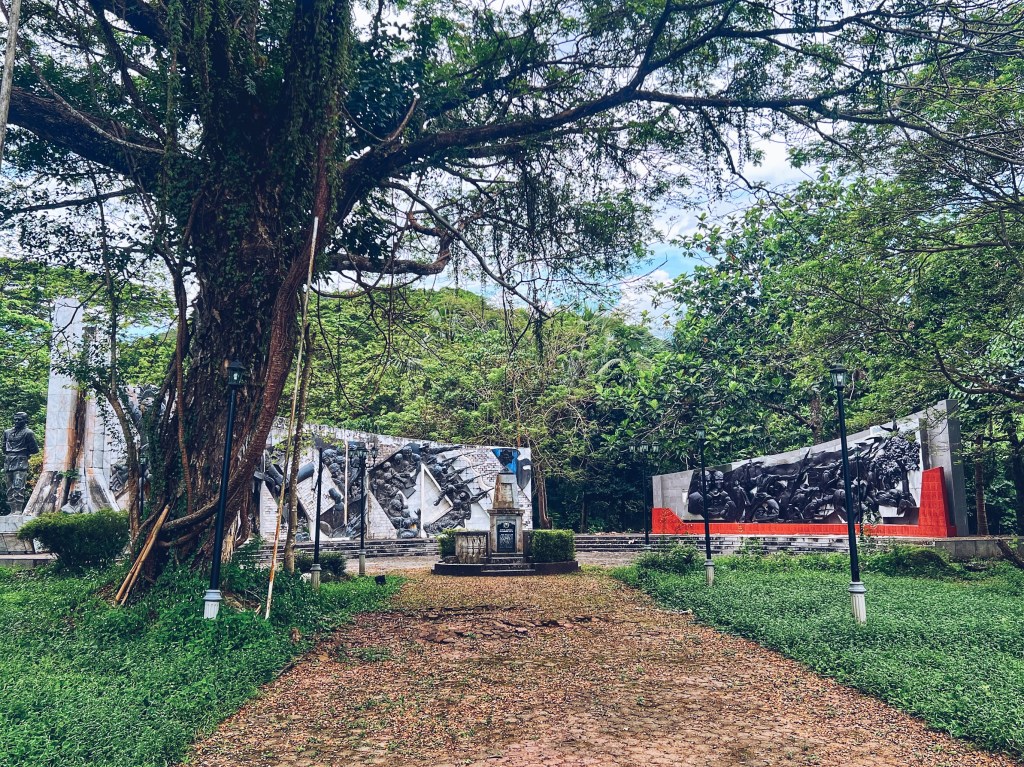
A few minutes later and we reach the Andres Bonifacio Shrine and Eco-Park. A few stray dogs emerge from the trees, looking thin and wary, their ribs visible under patchy fur. They follow us as we walk deeper into the compound, eyes fixed on us, or perhaps on the paper bag in Ate Lita’s hands. She takes out leftover Jollibee burgers from our morning snack and tosses them their way. The dogs lunge at the food desperately, as if personifying hunger itself.
Beyond them, the site reveals itself. The shrine is modest, quiet, and more wooded than I imagined. The trees cast a patchwork of shadow on the ground. There are no tourists other than us. The path narrows until it feels like we’ve stepped into a clearing meant more for silence than spectacle.
It is strange how solemn the place feels. It feels forgotten, yet strangely well-kept. The marker tells us it was here where Andres and Procopio Bonifacio were executed, though historians still argue whether the brothers met their end here or on nearby Mount Buntis. It hardly matters now. What remains is the stillness that obliges one to reflect. Somewhere beneath this soil, or somewhere near, the man who once called for freedom met the cold discipline of the very cause he began.
The Philippine Revolution began with everyone on the same page in terms of what the members wanted, but things were quite messy when it came to how they would achieve it. Andres Bonifacio started the Katipunan in 1892, aiming for a nationwide uprising based on equality and brotherhood. But as with any movement that grows bigger than its founder, factions emerged.
In Cavite, different groups started popping up. There’s the Magdiwang, who stuck to Bonifacio’s ideas; then there’s the Magdalo, headed by Emilio Aguinaldo’s cousin Baldomero, who was all about setting up a formal revolutionary government. Things got heated between moral authority and military strategy, and at the Tejeros Convention on March 22, 1897, Aguinaldo ended up being elected president while Bonifacio’s qualifications were called into question. Feeling humiliated, he called the election void in the Acta de Tejeros.
Bonifacio tried to bail from Cavite, but it turned into a disaster. He got arrested in Limbon, Indang, while his brother Ciriaco was killed. Aguinaldo’s men then took him and his brother Procopio to Maragondon, where they were tried and found guilty of sedition and treason—the punishment for which was death. Thus, on May 10, 1897, the two Bonifacios were executed. The irony was that Andres Bonifacio’s demise wasn’t by the colonial forces, but by the very revolution he started.
Revolutions usually start with a clear sense of right and wrong, but when everything falls apart, people start questioning loyalties and trust goes out the window. Bonifacio, the guiding light of the Katipunan, got caught up in internal rivalries and ambition, and Maragondon is a reminder that freedom isn’t just about fighting against oppression, but also about holding onto the values that make it worth fighting for.
Present Interlude: Maragondon’s Plaza, Church, and the Caingin River


After the shrine, we drive back toward the town proper. The road evens out again, the trees giving way to houses and convenience stores, as if the town has remembered to keep up with the present. The Bonifacio Trial House (officially the NHCP Museo ng Paglilitis ni Andres Bonifacio) stands near the entrance to town, so I tell P-Gwen we’ll go there last. I might as well explore the heart of Maragondon first before circling back to where the story begins.
We first stop at the small plaza in the middle of town. It’s almost exactly as I remember it from 2021, when I came here in the middle of the pandemic. I took a few photos then, but never wrote about it as my mind was elsewhere, heavy with other concerns. Now I take pictures again of the quiet streets, and of the church beside the square.
That church, the Maragondon Church (officially known as the Nuestra Señora de la Asunción Parish Church) is one of the few surviving Jesuit-built stone churches in Cavite. Construction began in the early 1600s, with the current structure completed in 1714 after the Jesuits rebuilt it using adobe and river stones. The church is notable for its Baroque façade with restrained ornamentation and its massive wooden doors, carved with floral and geometric designs—considered among the finest examples of 18th-century church woodcarving in the Philippines.
Inside, the church features a three-tiered retablo and intricately carved wooden pulpit, both of which have survived wars and natural decay. The entire structure was declared a National Cultural Treasure by the National Museum in 2001, recognizing its historical and artistic value.
From the plaza, we make our way to the Caingin River. The slope going down is steep, so it’s just me, Rona, and Ate Lita who take the walk. My parents stay in the car, and P-Gwen waits behind the wheel, hazard lights blinking.
At the bottom, the river glints faintly with its steady current unhurried under a cloudy afternoon sky. A hanging bridge sways gently nearby, and a few rafts bob lazily on the water. We don’t ride them; instead, we simply stand there, taking in the air.
Maragondon is one of the older towns in Cavite, tracing its origins to the late 1500s when Jesuit missionaries founded a settlement along the banks of the Caingin River. The name Maragondon is derived from the Tagalog word “maragundong,” meaning booming or echoing sound, said to refer to the rumble of the river’s current or the reverberating sound of thunder that often rolls through the nearby hills.
Under Spanish rule, the town became part of the encomienda of Mariveles before later being established as an independent parish. It thrived as a small agricultural community, with locals cultivating rice, bamboo, and woodcrafts.
For a moment, the town feels ordinary again, innocent even, as though its past were only a rumor. But Maragondon has a way of keeping its silences close. Beneath this stillness, the beginning of the story waits.
And so I return to it.
Inside the Bonifacio Trial House: The Revolution Devours Its Own


From the street, the Bonifacio Trial House doesn’t look like much. It’s an unassuming old wooden bahay-na-bato, with none of the grandeur or visual drama you might expect from a landmark of national consequence. If not for the marker out front, one could easily pass by without realizing that within these walls, the Supremo of the Katipunan faced his final reckoning.
We park by the roadside, and I start taking pictures from across the street. It feels like enough at first, until a guard appears by the gate and asks if I want to go in. Of course I do.
Inside, the first floor is simple: a bust of Andres Bonifacio and a few paintings on the walls surrounding it. The second floor, though, holds the weight of what transpired here. I walk through panels detailing Bonifacio’s arrest in Indang, the bitter factional split between the Magdiwang and Magdalo, and the eventual trial that sealed his fate. One display shows the mournful words attributed to Gregoria de Jesús, his widow, lamenting the unjust death of her husband.
After a few minutes of reading and taking in the silence, I step back out into the daylight. The house stands still, modest as ever, holding within it the story of how a revolution, once united by ideals, began to devour its own.
Leaving Maragondon: Confronting the Questions on the Revolution

The scenery around Maragondon seems to have its own stories to tell. The place has a very somber feel to it amidst the rolling hills where Bonifacio and his brother died. Victory in war isn’t the be-all and end-all, the town seems to tell us. It also involves the moral choices we make.
When we leave Maragondon, we understand things a little bit better, but we still don’t have clear answers. Here, bravery and betrayal stand next to each other. The risks of desire and the costs of idealism become more apparent.
Still, the fact that people make mistakes is what has shaped much of our past. Maragondon’s key sites make you think about things that don’t have simple answers: How might the revolution have unfolded if the Magdalo and Bonifacio had reconciled their authority instead of escalating the conflict? Was Aguinaldo really driven by the idea of freedom—or by the idea of power? Did their youth play a part in their fight? How would things have gone if they had been older and more experienced? What does it mean to fight for freedom but give up your own ideals? Can a country ever really balance its values with its desire for power?
Standing where Bonifacio once stood, we face these questions ourselves. The Revolution started and fell, but maybe it still lives in everyone who is willing to deal with the messiness of history.
Maragondon Travel Basics
Access
- Private vehicle: Maragondon lies about 55 kilometers southwest of Metro Manila. From Manila, take the CAVITEX and continue along Tanza–Naic Road toward Maragondon. Around two to three hours, depending on traffic.
- Bus: Take one bound for Ternate or Nasugbu at the Parañaque Integrated Terminal Exchange (PITX), and get off at Maragondon town proper. One-way fare costs around PHP 190.
Transportation
- The Bonifacio Trial House, the plaza, and the Caingin River are all located in the town proper and can be explored on foot.
- The Andres Bonifacio Shrine near Mount Nagpatong is about 9 km (or a 20-minute drive) from the town center. Best to go with a private car or motorcycle. Internet signal is spotty, so it’s download maps before you go.
Food
- Lolo Claro’s Restaurant – a local favorite for Filipino comfort food along Governor’s Drive. Think juicy fried chicken, lumpiang ubod, and halo-halo for dessert.
- Honorio’s Restaurant – offers native-themed dining and Filipino dishes with a twist (e.g. seafood kare-kare). Just a few meters north of Lolo Claro’s. Good if you want a little more sit-down feel.
- Nanay Intang’s Restaurant – highly rated family-run spot with generous portions and friendly service but a little out of the way from the town center.
Accommodation
- Maragondon is a day trip from Manila, but several small resorts and homestays are available in town or in nearby Ternate for overbight stays.
- Riverfront Garden Resort – Riverside cottages and open huts, great for groups. PHP 2,000 – 5,000.
- Ternate Beach Resort – Affordable beach-resort option near Maragondon. Day trip entrance fee PHP 100; cottages around PHP 500. Rooms PHP 2,000 – 4,000 for 2-6 pax.
For more practical information, contact the Maragondon Tourism Office. They regularly post updates on town events, historical sites, and eco-tourism attractions.
 The Tourist Gaze