
Winter Evening in Gastown: Vancouver Through First Impressions


Gastown’s Steam Clock releases a plume of white vapor into the cold night. Cobblestones damp from the slight drizzle earlier that evening reflect the amber streetlamps, giving the streets an ethereal, nostalgic feel. The misty, salty air from the nearby Waterfront harbor mixes with the smell of coffee and pubs while a light fog softens the sound of footsteps and street music.
My brother Joseph and I are in this Vancouver neighborhood after handling a small errand. Earler today, my family arrived in this city after a lengthy trip from Manila, and Joseph had purchased day pass tickets for public transit. Our plan to rely on buses and walking fell through, however, as navigating the city on foot was challenging for my parents. So instead, we rented a car that can also carry our parents’ wheelchairs, leaving the day passes unused.
It’s the first night of our most recent visit (our first Vancouver trip was in 2012), and already the city feels larger than the reasons that have brought us here. After a short rest in Joseph’s place in southern Vancouver, my brother and I make our way to the Waterfront terminal via the Skytrain. The terminal, with its polished floors and classical columns, was my first real point of contact with Vancouver’s pulse, the threshold between arrival and the city proper, probably just as it was for my brother nearly two years ago.
Refunds sorted, we decided to wander a bit, which brings us here in Gastown. The neighborhood is busy, with people moving between restaurants and shops, yet it still feels laid-back.
“The first time I went to Gastown, I was completely amazed,” Joseph says. “The Steam Clock was the first thing that caught my attention. But it wasn’t just the clock. The whole neighborhood, the streets, even the train and the Waterfront terminal — everything felt so vast. It was nothing like back home.”
This is Joseph’s city now, the home he had slowly built over nearly two years. But for the rest of us—me, my parents, my sister Yanyan, and Ate Lita (who has been with our family for more than 30 years and even took care of Joseph when he was a toddler)—everything still feels new.
Vancouver: A City of Immigrants


Vancouver, perched between the Pacific Ocean and the Coast Mountains, grew from a small sawmill settlement in the late 19th century into one of Canada’s most dynamic cities. Incorporated in 1886, it quickly became a hub for trade, shipping, and railroads, connecting the Pacific coast to the rest of Canada.
Evidence of Vancouver’s early days are still seen in its streets and neighborhoods, from the historic timber and brick architecture of Gastown to the grid patterns shaped by the railway lines. The city’s evolution was rapid, shaped by its natural harbor, abundant resources, and strategic location. But it was not without challenges, with fires, economic booms and busts, and the displacement of its Indigenous peoples all marking its growth.
From the city’s earliest days, immigrants played a crucial role in shaping Vancouver’s character. Workers from China, Japan, and Europe helped build the railroads and docks, while later waves from South Asia, the Philippines, and Latin America added to the city’s cultural fabric. Today, over half of Vancouver’s residents were born outside Canada, making it one of the country’s most diverse cities. This history of migration has influenced everything from cuisine and festivals to neighborhood identities. This gives Vancouver a unique blend of global cultures while reflecting the ongoing tensions and triumphs of integration.
It was into this city of diverse communities that Joseph had arrived nearly two years ago, carving out a life of his own while navigating the same streets that generations of immigrants had walked before him. He had arrived on a student visa, ready to begin his MBA at the University Canada West. It was a stepping stone toward his ultimate goal of becoming a permanent resident.
And now, he’s about to graduate, which is why we’re visiting him—to attend the graduation ceremony and reconnect after all this time.
Brunch at Granville Island: Immersing into the City


A couple of mornings later, having settled into the city, the whole family make our way one morning to Granville Island. The plan is to have brunch before driving Joseph to his work in Annacis Island, a 30-minute drive from downtown Vancouver. We’re ready to experience another side of Vancouver and see how Joseph has made this place his own.
Granville Island’s pavement is slick and dark from the morning drizzle, with gray skies providing muted light all over the city. Yet the bright splashes of color from produce, artisan goods, and market signage, stand out against the gloomy tones of the overcast morning.
Joseph leads the way, effortlessly weaving through the market as though he belongs. He points out a restaurant where he and Karthik—an Indian schoolmate and roommate he’s been living with for the past year—once grabbed lunch. Karthik cooks oftentimes, Joseph mentions, though sometimes they would like to explore the city’s flavors. He points out his favorite bakeries and coffee stalls, clearly indicating that he has made this corner of Vancouver part of his world.
Granville Island, a former industrial area turned cultural hub, stretches along the waterfront just south of downtown Vancouver. Today, it’s a popular spot for tourists and locals alike, known for its public market, artisan shops, breweries, and waterfront views. Usually, it pulses with a mix of commerce, creativity, and community, giving visitors a glimpse of the city’s buzzing local life.
But on a chilly, damp morning, with only a handful of people wandering the slick, gray streets, the whole area feels forlorn. Inside the market, however, is a different story. The vibrant colors of fruits and the sharp orange and yellow of various cheese all vie for attention. Vendors arrange their goods with the precision of someone doing it for so long. The chatter of people rises around us, punctuated by the occasional clink of dishes and crates being moved. We pick out some fresh fruits, but decide that we prefer a proper meal than the light bites sold in the market.
So we settle at the Tap & Barrel a few meters away. It’s a bar and restaurant, but in the morning is cozy enough for a family brunch. We are seated at a table near a heater, which provides a welcome reprieve from the cold. The warmth seeps in slowly, mingling with the savory scents drifting from nearby tables. I dig into my protein bowl, which features Moroccan chicken slices sharing space with quinoa and peppery arugula. The rest of us tuck into burgers and pasta dishes. I sip my Coke Zero regularly, to allow the crisp fizz to provide a refreshing contrast to the hearty meal.
The relaxed conversations of other diners with one another make the morning feel cozy, even as drizzle continues outside. As for us at our table, our talks range from small talk to reflections on Joseph’s life in the city and his future plans.
Watching Joseph move confidently through the market and the stores of Granville Island, I’m seeing how he has woven himself into the city. It’s all become familiar to him, a testament to the life he has built far from home.
A Morning Jog And a Walk along Main Street


The next morning, I decide to go for a jog. From Joseph’s place, I try a light pace, but the cold drizzle and the fact that I haven’t had cardio for a few days leaves me winded after just two blocks. So the jog turns into a brisk walk. Nevertheless, after about half an hour, I reach Queen Elizabeth Park, perched on Little Mountain and offering one of the few elevated views of the city. Even in winter, the park’s winding paths, open lawns, and carefully tended gardens make it a favorite spot for locals to exercise, relax, or simply take in Vancouver’s skyline.
As I stroll, I spot man tossing a ball for his golden retriever across a wide expanse of grass. A group of elderly Asian women do morning stretches near the Bloedel Conservatory. Aside from these few souls, the park feels empty, with only the soft patter of drizzle on leaves and the occasional sounds of cars in the distance. I pause to gawk at the conservatory’s glass dome but don’t enter, before strolling toward the Quarry Gardens. Even in early winter, with muted tones and puddled pathways, the gardens retain a subtle, understated beauty. Having my fill of green views and damp earth, I return to our place.
At noon, Joseph is ready to leave for work. I walk with him to the bus stop near Main Street, following streets I’ve only glimpsed from a car. Main Street is lined with small cafés, second-hand shops, and colorful murals. The sound of traffic mixes with the drills from streets being renovated. Cars and buses pass at regular intervals, providing a steady pulse that matches the orderly grid structure of the neighborhood.
Walking with Joseph, I notice how naturally he navigates the sidewalks, a stark contrast to my own tentative steps in the city. He strolls the streets like a local, though Karthik often teases him about being overly cautious. (If he were here, he’d probably stride ahead, weaving through puddles without a second thought.) This reminds me of the many times back in the Philippines when we accompanied each other to errands and appointments, only now the city around us is completely different.
Later that evening, Yanyan, Ate Lita, and I head toward the waterfront to visit the Vancouver Christmas Market while my parents opt to sit in the warmth of the nearby Vancover Convention Centre.
Downtown Vancouver: Job Interview and City Life


Joseph has taken a leave from work the next day for a job interview at a bank’s main office downtown. The position aligns more closely with his MBA, and, perhaps just as importantly, it’s much nearer to his place. He’s hopeful, walking into the towering glass building with the intensity of someone who knows what’s at stake.
Meanwhile, I wander a few blocks away to catch a movie at a nearby theater, the cold air nipping at my cheeks. Yanyan and Ate Lita head to a mall, browsing through stores. By early afternoon, the two return to pick up my parents, who stayed behind at our place. Joseph and I will meet them downtown, giving us a few minutes to kill.
We take advantage of the time for a small photoshoot and video session, since Joseph is dressed sharply in his corporate attire, and the downtown skyline and bustling streets providing the perfect backdrop. Pedestrians pass, a mix of office workers, tourists, and locals. It feels cinematic, the city becoming alive around us while Joseph prepares for the next step in his professional life.
When the rest of the family arrives, we head to the food court in Pacific Centre, a mall that is always busy but not to the point of overwhelming. It’s also where Karthik works, though we don’t get to interact with him. Joseph’s schedule differs from Karthik’s, but the two still find time to cook together, run errands, or meet for whatever they need to meet for, their friendship steady amidst the demands of city life.
We grab a late lunch, forgetting the drizzle outside for the moment as we chat about the morning’s events. Even in an everyday setting like a mall, Vancouver’s energy reflects the ambition Joseph has while carving a space for himself here.
Kitsilano Charm and a Downtown Parking Mishap


We invite Karthik to tour the city with us the next day since it’s his day off. The whole family, along with Karthik, first heads to Kitsilano Beach. “Kits Beach,” as it’s often called, is a popular Vancouver waterfront destination known for its sandy shore with views of the mountains and city skyline. It’s a favorite spot for swimming, sunbathing, beach volleyball, and casual strolls, especially in the warmer months. On a December afternoon, though, gray skies hang overhead. It’s not quite raining, but it’s cold enough to make the neighborhood feel almost deserted. The beach has a much quieter charm in winter, with the occasional cyclist or dog walker punctuating the stillness.
After exploring the beach for a while, we drive downtown to have late lunch at an Asian restaurant we saw on Google Maps. Confident it will be a quick stop, I park at a curbside spot across from the restaurant. As soon as I finish my meal and step outside, though, I notice a tow truck starting to clamp our car. Heart racing, I hurriedly call Yanyan, and together with Karthik, we rush across the street to intervene. In the end, we miss it by a few seconds, but another tow truck driver points us to the impound number, and we soon take an Uber—me, Yanyan, and Karthik—to sort everything out. Meanwhile, our parents and Ate Lita wait comfortably at a hotel lobby nearby.
That evening, after Joseph returns from work, we take a short walk to a Tim Hortons branch near the bus stop he uses daily. The plan is to grab a cup of coffee for our dad, who’s been craving one all afternoon.
As we stroll along the silent streets, damp from the day’s drizzle, the familiar scent of brewing coffee drifts from the café. The lights from shop windows reflect on the wet pavement, casting a soft glow on the sidewalks. The walk stirs a memory of late-night trips to a nearby 7-Eleven back home in the Philippines. Back then, either he or I would casually say, “Let’s go to 7-Eleven,” and off we’d go for a late-night snack. Such mundane routine now feels like a bridge between two cities and two lives.
A Sunny Afternoon in Stanley Park: A Prelude to Weekend Adventures

It’s a sunny Friday afternoon. My dad is down with a headache, while Joseph is at work, so it’s just me, my mom, Yanyan, and Ate Lita heading out. Our first stop is Stanley Park, Vancouver’s largest urban park and one of the city’s most famous landmarks. Spread over nearly 1,000 acres, the park is a mix of dense forests, winding trails, and scenic waterfront paths, offering both locals and visitors a chance to escape the bustle of the city. Even in early December, the winter sun illuminates the towering evergreens and the sparkling waters of the harbor, creating a striking contrast between nature and skyline.
We make our way to the park’s iconic Totem Poles, a collection of intricately carved wooden monuments representing stories, legends, and cultural traditions of the First Nations peoples of British Columbia. Each totem tells a tale of animals, ancestral spirits, or historical events with lively colors and meticulous detail that stand out against the deep greens of the surrounding forest. Seeing the totems in person brings a sense of connection to the land’s history, reminding visitors that Vancouver’s identity has been shaped by centuries of Indigenous presence and culture long before urban development began.
After soaking in the park, we drive to Capilano. Our plan is to catch a glimpse of the lights in the evening. This gives us a taste of the city’s natural beauty and festive charm.
Over the weekend, we also have other day trips: Saturday at Merry & Bright Martini Town to meet a family friend, and Sunday exploring Whistler and the Sea-to-Sky Gondola. The latter two especially mix city and mountain experiences, highlighting the diversity of British Columbia’s landscapes and the ways we can weave both nature and urban life into our visit.
Exploring Vancouver on Foot: Science World, Olympic Village, and Cambie Bridge


After the whirlwind weekend of driving and sightseeing, Joseph and Karthik return to their respective work, while we decide to take a breather. That afternoon, though, Yanyan needs to head back to a downtown mall to pick up a Lululemon order. I accompany her on the way, taking the chance to move through the city at a slower pace.
Yanyan drops me off at Science World, a striking geodesic dome perched on the edge of False Creek. The museum is one of Vancouver’s most recognizable landmarks, popular with both families and tourists for its interactive exhibits, science demonstrations, and panoramic views of the waterfront. Even without entering, the surrounding area offers lively sights and a glimpse of city life along the water.
I continue my walk along the waterfront to the Olympic Village, a neighborhood originally built for the 2010 Winter Olympics. Its modern architecture, pedestrian-friendly paths, and lively cafes create a sense of energy despite the quiet winter afternoon. From there, I cross Cambie Bridge, occasionally slowing down enough to take in the views of False Creek and the downtown skyline reflected in the water, before making my way downtown (walking fast, faces pass, and I’m homebound, heh).
At the mall, I reunite with Yanyan and eventually meet with Karthik, who has just finished his shift. Together, we take our time at the food court before driving home, winding down the day with a more relaxed pace compared to the packed schedule of the past few days.
Queen Elizabeth Theatre: A Moment of Arrival

We find our seats inside the Queen Elizabeth Theatre, far enough from the stage to take everything in, but still close enough that I can get a good view. When the doors open, two men in red uniforms step forward, blowing bagpipes, which fill the hall with solemn, almost old-world music like some remnant of a British tradition.
And then there he is, walking down the center aisle with his fellow graduates.
For a moment, Joseph looks like a high schooler: shorter than many of the students around him, especially the tall South Asians who fill much of his cohort. But he looks confident, shoulders squared, and steps steady. If he’s nervous, it doesn’t show. He walks like someone who has earned his place in this room.
The ceremony is brisk, almost technocratic—brief messages, minimal theatrics, and then the roll call of graduates striding across the stage one by one. When Joseph’s name is called, I don’t even look at my parents. I’m too focused on the screen of my phone, recording him as he moves across the stage. Pride and happiness wash over me.
As I watch him, memories thread their way in my head. I remember those early months after he first moved to Vancouver, when he would videocall me often, perhaps out of homesickness, or the disorientation of adjusting to a new country. Those calls came less and less as he settled in, built routines, found friends, and carved out a life independent of the one he left in the Philippines. Watching him walk across that stage, I feel almost certainly that he’s no longer adjusting. He now belongs.
Outside, the sky has turned into a typical Vancouver gray—overcast with a light drizzle as the crowds spill out of the theatre lobby. Families gather under umbrellas as graduates hold their bouquets with pride. Joseph huddles us together, stretches out his hand holding his phone and says, “Let’s take a picture.”
We take photos by the entrance. Karthik, who will have his own graduation next summer, wraps him in a congratulatory hug. Despite the cold air and the wet pavement, there is warmth in this simple, unembellished pride.
This graduation marks a turning point for Joseph: the transition from studies into the next chapter. He will now have to deal with applications, work permits, and the slow, and maybe grueling process of building a long-term life here. For our family, it is affirmation that all the sacrifices, all the years of waiting, all the small uncertainties carried from Manila to Vancouver were worth it.
Everything before this ceremony leads here. Everything after will be shaped by what this moment makes possible.


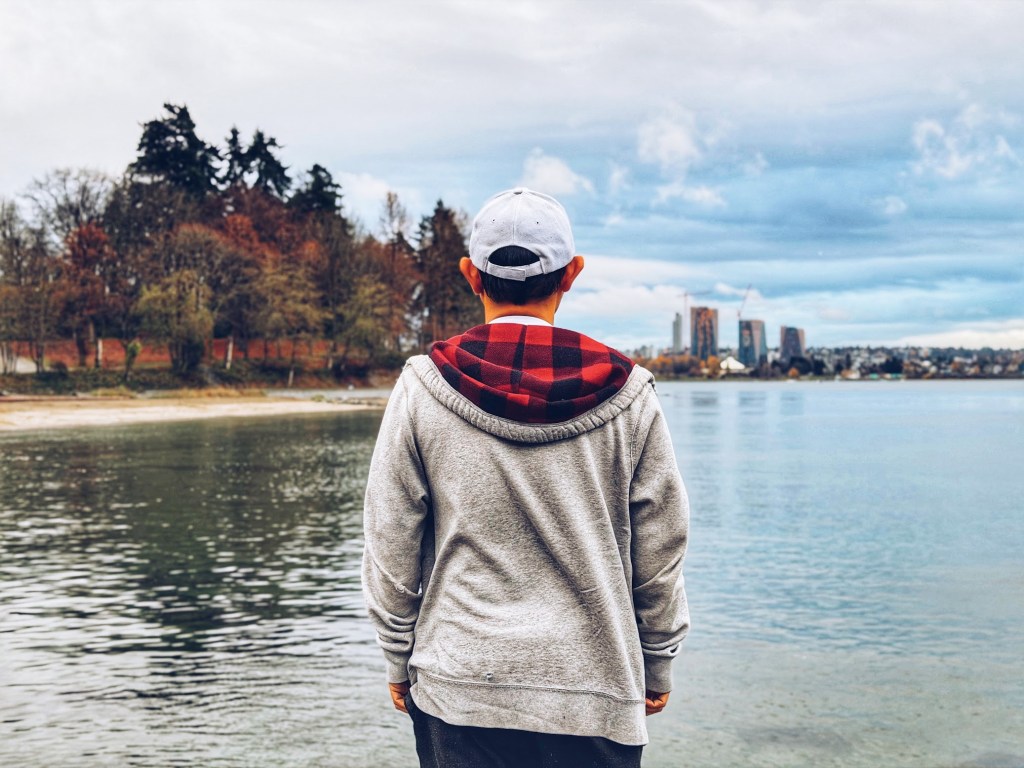
One afternoon, Joseph and I stroll along the Stanley Park Seawall. The skyline looms across the harbor, softened by mist and low-hanging clouds, while the water mirrors muted grays and silvers. The sky is a layered wash of pale blues and steel, and though the sun struggles to break through, the city feels luminous in the diffused winter light.
Joseph walks beside me, our proximity bridging the spatial and temporal distance that have stretched between us for the past two years. I remember the young brother who once tagged along for late-night trips to 7-Eleven, and I smile at how far he’s come. He’s built a world of his own here, and for the first time, I can see the life he’s chosen. Where he was restless and unsure of what he wanted, he’s now steady and purposeful. That certainty feels in tune with the gentle lapping of the waves and the rustle of seawall trees.
Vancouver hasn’t demanded anything from him except being honest with who he is. He does not need to reinvent himself nor keep up with certain performances. He does not need to rush to prove he belongs. The city has given him space to slow down and let his past settle without being erased. In this city of people who have tried to find better lives for themselves, he can be anonymous when he needs to retreat and seen when he’s ready to reach out. The city is revealing itself at the pace of a person finally learning to stay. And here, along the seawall where the water meets the mountains, he has stopped feeling in transit. For the first time in a long while, he is home.
“It’s a bittersweet feeling,” he tells me. “Bitter because of all the challenges; sweet because the feeling is great when you overcome them.”
In that overcast afternoon, I feel a calm acceptance. Joseph is exactly where he needs to be. And for my dad, my mom, my sister, Ate Lita, and I, we’re just passing through, grateful to witness one of us finally finding his place in the world.
Vancouver Travel Basics
Timing
- Best seasons are spring (Mar–May) and autumn (Sep–Nov) for mild weather and fewer crowds.
- Winter (Dec–Feb) is cool and drizzly, 3–8°C (37–46°F). Shorter days, cozy cafés, indoor markets, and winter festivals.
Access
- From YVR (Vancouver Airport):
- SkyTrain Canada Line: 25 min to Waterfront Station, CAD 3.35–6.60.
- Taxi / Rideshare: 30 min, CAD 35–50.
- SkyTrain Canada Line: 30 min, CAD 20–35.
- From the U.S. Border: Drive 2–3 hrs from Seattle (I‑5 North), or bus/shuttle 4 hrs.
- By train: Amtrak Cascades (Seattle–Vancouver, 4 hrs) or VIA Rail (from Canadian cities). Customs at border.
- By ferry/cruise: Alaska cruises dock at Canada Place; BC Ferries from Vancouver Island (Victoria/Nanaimo).
Transportation
- Public transit: Buses, SkyTrain, SeaBus.
- 1‑zone: CAD 3.35 (cash/contactless), discounted CAD 2.70 with stored value.
- 2‑zone: CAD 4.85, 3‑zone: CAD 6.60.
- DayPass: CAD 11.95 (all zones, all modes).
- Walking is excellent for neighborhoods like Gastown and Main Street.
- Car rentals useful for families, mobility considerations, or exploring beyond downtown.
Accommodation
- Luxury/Midrange: Fairmont Waterfront (CAD 350–450 per night), historic charm and central location; Wedgewood Hotel & Spa (CAD 400–500 per night), refined boutique, downtown area; Pan Pacific Vancouver (CAD 300–400 per night), waterfront, near major attractions.
- Budget: YWCA Hotel Vancouver (CAD 90–120 per night) simple rooms, central location; Samesun Vancouver (CAD 50–80 per night for dorm beds, CAD 100–130 for private rooms) social, hostel-style environment; HI Vancouver Downtown Hostel (CAD 60–90 per night for dorm beds, CAD 120–150 for private rooms) clean, conveniently located from downtown.
- Private rentals offer flexibility for longer stays.
Food
- Tap & Barrel – burgers, protein bowls, pasta, and salads.
- Granville Island Public Market – local produce, artisan goods, and snacks.
- Miku – aburi sushi (flame-seared)
- Jam Cafe – brunch, generous portions,.
Cafés
- Tim Hortons – Canada’s iconic coffee chain. Coffee and donuts.
- Blenz Coffee – espresso drinks, lattes, and seasonal specialties.
- Revolver – Gastown specialty coffee shop.
- 49th Parallel Coffee Roasters – espresso and pour-over options.
- JJ Bean Coffee Roasters – homegrown chain with strong coffee and light bites.
For more practical information, visit Destination Vancouver.
More from the A British Columbia Winter Family Trip Series
- In Vancouver, My Brother Finally Found His Place
- Vancouver Christmas Market: A European Holiday Magic in the Waterfront
- Capilano Suspension Bridge Canyon Lights: A Magical Vancouver Holiday Experience
- Merry & Bright at Martini Town: A Festive Winter Wonderland in Langley Township, BC
- Whistler: A Family Morning of Alpine Beauty and Winter Olympics Legacy
- Sea to Sky Gondola in Squamish: Summit Views and Suspension Bridge Experience
- Victoria, BC: A Day Trip of Memories and Unexpected Reunion
- Peace Arch Park: We Planned a Vancouver “Farewell” Trip—And Ended Up at the U.S. Border
 The Tourist Gaze