
A Vancouver Day Trip Across the Shore: Setting Out to Victoria

We start our day trip to Victoria leaving from Joseph’s place. We’ve been in Vancouver long enough now that time feels a bit weird—like we have forever, but also no time at all. We keep putting off the things we want to see, telling ourselves, “maybe later,” just because we feel like we have so much time left. It’s a funny trap you fall into once a new city starts feeling like home.
After all, our visit to Vancouver has never been really about sightseeing. We are here for Joseph. His graduation a week earlier has been the anchor of the trip, and the reason our family are in Canada in the first place. Victoria, in that sense, is almost an afterthought. We even toyed with the idea of skipping it altogether, dulled by travel fatigue (especially after the trip to Banff and Calgary a few days earlier) and the comfort of simply being together.
It was only in the final days, when the reality of leaving began to surface, that Yanyan said it plainly: we don’t have time. And so we go.
After breakfast, we head south. The drive to Tsawwassen feels automatic by now, partly because city life just becomes routine, but mostly because we’ve made a few trips to the outlet mall there. We get to the terminal right in time for the 11 a.m. sailing. While we’re stuck in the lineup, a seagull hop onto our side mirror and just chills there for fifteen minutes, totally unbothered, like it has nowhere better to be.
Once on the ferry, the contrast is immediate. Inside the car deck, everything feels sealed and still; outside, the wind is sharp and the cold persistent. The sky is a uniform Vancouver gray, though there’s no rain. As the ferry pulls away, the skyline slowly dissolves into the distance.
Discovering Victoria, BC’s Colonial Capital


Victoria, the capital of British Columbia, traces its origins to a Hudson’s Bay Company trading post in the mid-19th century, later becoming a hub for colonial administration. Its streets and architecture still reflect that history, from the elegant neo-classical and Edwardian buildings in the Inner Harbour to the preserved charm of neighborhoods lined with heritage homes. The city’s development was shaped by its coastal location, mild climate, and strategic significance, giving it a character distinct from the bustling mainland.
The city’s history is deeply intertwined with the broader story of British Columbia and its relationship to Vancouver. While Victoria emerged as the colonial capital and administrative center of the island, Vancouver developed later as a commercial and transportation hub on the mainland, fueled by railways, shipping, and resource industries. The two cities have always been connected by both geography and commerce, with the Strait of Georgia linking them physically, and trade, migration, and tourism linking them socially and economically.
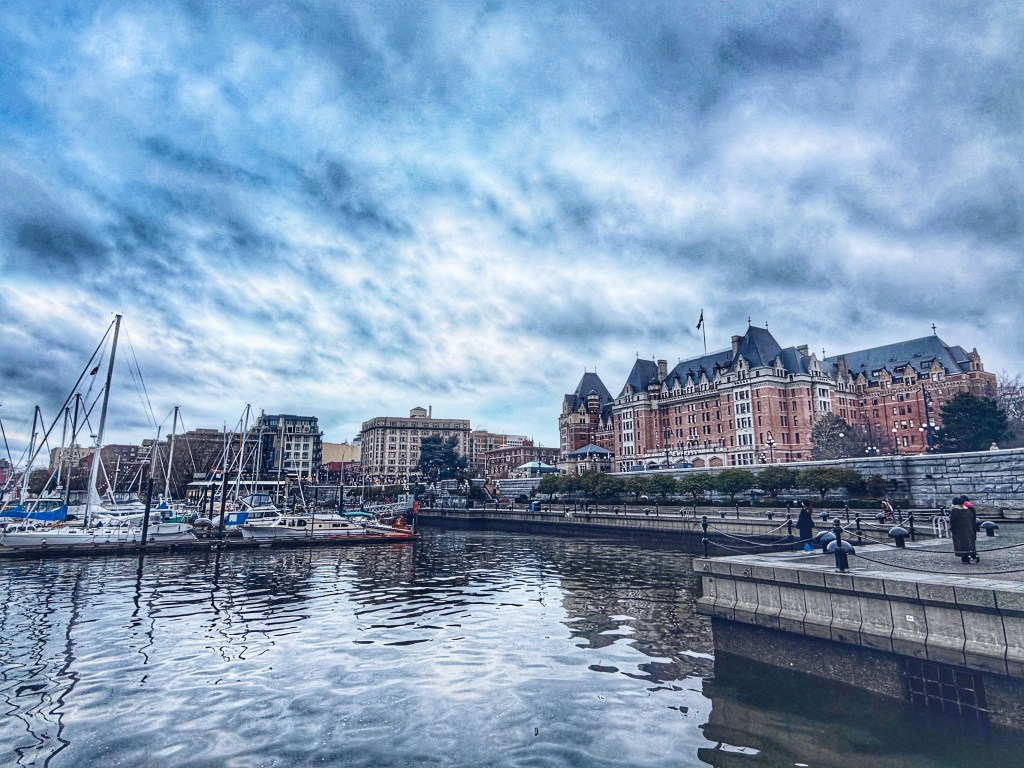
For travelers, Victoria is a compact, walkable city rich in both culture and scenery. The Inner Harbour serves as a central gathering point, framed by historic landmarks. Its waterfront paths, parks, and floating villages provide intimate encounters with the city’s maritime life, while curated gardens, boutique shops, and cafes invite leisurely exploration. Even in winter, when gray skies soften the light, the city’s colors create a subtly picturesque charm.
Fisherman’s Wharf: Family Lunch by the Waterfront

The ferry arrives in Vancouver Island, and a few minutes later, we’re driving from the port south to Victoria, the capital of British Columbia.
Our first stop is to have lunch at the Fisherman’s Wharf, a small floating village of colorful homes and docks, historically home to working fishing boats. Today, it’s a quiet tourist spot, where floating homes, small boats, and local eateries mix with visitors strolling the pier, all merging into a playful, informal atmosphere that’s a little less curated than other city landmarks.
The colors grab our attention: the floating houses are painted in these bright, kind of random shades, just bobbing in the water. With the boats rocking nearby and the soft winter light, the whole place feels chill. There are a few people walking around speaking different languages—maybe tourists, maybe just locals—you can never really tell here. Between the sound of the waves and the seagulls, the air feels slow and calm, which is exactly what our fatigued family needs.
We shuffle toward lunch almost on autopilot, until we spot a Mexican seafood restaurant tucked along the wharf. Orders are simple and satisfying: quesadillas for most, a burrito for Dad, carne asada birria for me, and nachos for Yanyan. The food is not remarkable, but more importantly, it’s filling and it provides nourishment after the ferry and the drive.
As we eat, we meet what I assume is a Filipino couple at the next table. The woman was originally from Zambales, but has settled in Victoria. The man, on the other hand, is from mainland B.C. and is visiting for the weekend. We trade stories about life in Vancouver and Joseph’s nearly two years living there. Their 16-year-old dog is seated on a chair beside them, bundled in a thick blanket, somehow providing the metaphor of time passing, of journeys that continue even after some trips end.
After lunch, we drive to the house of another friend, Sherilyn, to deliver a package for her husband, Ced, sent by his mom. The couple has been based in Victoria for more than a year now, roughly the same time as Joseph in Vancouver. We meet She and her newborn in front of their apartment, quickly take a few pictures, and return to the Inner Harbour.
Fairmont Empress and the Inner Harbour: Nostalgia and Family Moments


We return to the harbor specifically for the Fairmont Empress. The hotel, opened in 1908, is a landmark hotel that dominates Victoria’s Inner Harbour. Its grand architecture, formal gardens, and historic tea rooms have made it a symbol of the city, drawing visitors for both its beauty and its history. For us, though, it’s the heart of our Victoria memories outside Butchart Gardens (which we don’t get to visit this time due to time constraints and is anyway technically outside Victoria). In 2012, we stopped here, letting the gardens and the grandeur of the building soak into us. Thirteen years later, curiosity draws us back. The Empress feels familiar but subtly different: the sign above the entrance is the same, but the gardens are now cordoned off, with some plants now gone, and the muted winter light softening the building’s presence.
A tour bus had arrived, spilling out tourists taking pictures and chatting with one another. Our parents maneuver their electric wheelchairs along the front, focusing on the view. Ate Lita flits around in her usual nonchalant manner, capturing the scene on video. Yanyan, the designated driver for this trip, is somewhere looking for a parking space.
Joseph wants to do a composite photo, with his 2012 pose recreated in 2025. I guide him into position, framing him in the same spot. Afterwards, I can’t resist separating briefly to explore on my own, with the harbor and nearby landmarks calling for attention. The Parliament Buildings, completed in 1897, house the Legislative Assembly of British Columbia. Their neo-baroque architecture and prominent waterfront location make them one of the city’s most iconic and photogenic landmarks. Our time here is short, so my travel photographer instincts kick in, feeling victorious in maximizing the clustered sites before we have to leave.
I return just in time as Yanyan arrives as well. We enter the hotel to use their washroom. Inside the Empress, the contrast is immediate. Warm lighting replaces the muted gray outdoors, tea rooms buzz with chatter, and the clinking of teaspoons punctuates conversations. Guests in elegant attire moved with purpose, yet the space somehow feels inviting and even intimate. Even in grandeur, there can be calm.
Standing there, bridging our 2012 visit and the present, I feel the tug of nostalgia and a growing awareness that our time in Victoria is short. I wonder if we should have lingered longer, maybe even stayed overnight. Still, in that moment, surrounded by family and familiar sights, the city feels liminal, suspended between memory and the present. It’s caught between continuity and change.
Beacon Hill Park and Mile Zero: Inspiration and an Unexpected Reunion

With daylight fading, we return to our car and drive to Beacon Hill Park, a sprawling green space in downtown Victoria, offering walking trails, ponds, manicured gardens, and views of the ocean. It has been a public park since the late 19th century and provides both locals and visitors a peaceful escape from the city streets.
We make a singular stop at Mile Zero, which marks the beginning of the Trans-Canada Highway and sits within the park. The site includes a statue of Terry Fox, honoring the Canadian icon’s cross-country marathon for cancer research. Early evening shadows stretch across the pavement, and the rushed pace is unavoidable, as we have to return to the terminal in time for the ferry back to Vancouver. Still, even in the short visit, nostalgia hits hard. The Fox statue and the Mile Zero marker stir thoughts not only of inspiration but the unstoppable passage of time.
Yanyan and I are the only ones to hop out for a photo with the statue while the rest of the family wait in the car. Just as we are wrapping up, a familiar truck pulls up. It’s Jacob, an old friend who’s been living in Victoria since 2018. We are touched with the effort. Most people would have just used the tight schedule as an excuse and say “maybe next time,” and it will be fine. But Jacob actually made it happen.
There isn’t time for a proper dinner, though, so he suggests a quick Starbucks run at Uptown. There, we take photos together before we make our way back to the port for the ferry ride back to Vancouver.
Getting comfortable on the ferry ride home, it hits us that our time here is running out, and we’ll have to say goodbye to Joseph soon. Even so, everything that happened today—especially that surprise reunion—keeps our spirits up.
Victoria, BC Travel Basics
Timing
- Victoria is enjoyable year-round, but spring and summer (May–September) offer the best weather and long daylight hours, though crowds are higher. Fall and winter are quieter, with shorter days and occasional rain, but landmarks like Fisherman’s Wharf and the Fairmont Empress feel more peaceful.
- For a day trip from Vancouver, morning ferries (7-11 a.m.) maximize sightseeing time, and the ferry ride itself is a scenic part of the experience.
Access
- Victoria is most easily reached from Vancouver by ferry. BC Ferries runs regular sailings from Tsawwassen Terminal to Swartz Bay, about 90 minutes each way. One-way fares for passengers walking on range from CAD 15–21 for adults and CAD 7.50–10.50 for children; children under 5 ride free. If bringing a car, fares start around CAD 75–89, with saver fares (limited availability) sometimes as low as CAD 34–71. Booking in advance is recommended, especially for vehicles.
- Once you arrive at Swartz Bay, it’s about 30–40 minutes to downtown Victoria. Options include:
- Car rental or personal vehicle: The most flexible option, especially if visiting multiple landmarks.
- Taxi or rideshare: Convenient, around CAD 60–80 one way for a standard car.
- Public transit: BC Transit Route 70 connects Swartz Bay to downtown Victoria in roughly 1 hour, with multiple departures daily. Tickets are around CAD 5 per adult.
- Shuttle services: Some companies offer scheduled shuttle vans to the Inner Harbour, usually CAD 20–25 per person.
- For a faster but pricier option, floatplanes by Harbour Air from downtown Vancouver land at Victoria’s Inner Harbour in about 30 minutes. Prices typically start at around CAD 150 per person for a one-way trip, offering stunning aerial views of the Strait of Georgia.
Transportation
- Victoria is a compact, walkable city, especially around the Inner Harbour, Fisherman’s Wharf, and downtown landmarks. Walking is often the fastest and most scenic way to move between sites.
- For longer distances, options include:
- Car rental: Flexible if you plan to visit places like Beacon Hill Park or Butchart Gardens outside the city center.
- Public transit: BC Transit buses cover most of the city and nearby neighborhoods. Single fares are around CAD 2.50–5.
- Biking: Several rental shops and bike-share programs allow cycling along waterfront paths and through parks.
- Taxi or rideshare: Convenient for families or groups; fares depend on distance but typically CAD 10–20 within downtown.
- For a day trip, walking combined with a rental car or occasional taxi usually covers all major sights efficiently.
Accommodation
- Victoria can certainly be done as a day trip from Vancouver, but spending at least one night lets you explore more leisurely and enjoy the city after the day‑trippers leave.
- Fairmont Empress – Historic luxury overlooking the Inner Harbour, ideal for a classic Victoria experience (from around CAD 480 per night, though discounts are sometimes offered).
- Best Western Plus Inner Harbour – A reliable value choice within walking distance of major sights (around CAD 290 per night).
- Quality Inn Downtown Inner Harbour – Basic and budget‑oriented near central Victoria (around CAD 120 per night).
- If you want something a bit more quiet or luxurious outside the city core, places like Oak Bay Beach Hotel offer more resort‑style stays (around CAD 670 per night).
Food
- Victoria offers a mix of casual harbor-side spots, elegant historic venues, and local favorites. For a day trip, prioritize walkable areas like Fisherman’s Wharf and the Inner Harbour for quick access, memorable views, and a taste of the city’s maritime charm.
- Fisherman’s Wharf – Casual waterfront eateries with colorful floating homes. Quick lunch, seafood, or a relaxed bite while taking in harbor views.
- Fairmont Empress Tea Room – Experience classic afternoon tea in a historic setting. Expect around CAD 65–75 per person for a full tea service. Also serves meals.
- John’s Place Restaurant – A long‑time local favorite for breakfast and brunch with scratch‑made comfort classics. Great for fueling up before or after exploring downtown Victoria.
For more practical information, visit Tourism Victoria’s official website.
More from the A British Columbia Winter Family Trip Series
- In Vancouver, My Brother Finally Found His Place
- Vancouver Christmas Market: A European Holiday Magic in the Waterfront
- Capilano Suspension Bridge Canyon Lights: A Magical Vancouver Holiday Experience
- Merry & Bright at Martini Town: A Festive Winter Wonderland in Langley Township, BC
- Whistler: A Family Morning of Alpine Beauty and Winter Olympics Legacy
- Sea to Sky Gondola in Squamish: Summit Views and Suspension Bridge Experience
- Victoria, BC: A Day Trip of Memories and Unexpected Reunion
- Peace Arch Park: We Planned a Vancouver “Farewell” Trip—And Ended Up at the U.S. Border
 The Tourist Gaze