
The Drive from Banff to Calgary: From Mountain Awe to Prairie Roots


The ninety-minute drive from Banff to Calgary marks a sharp transition from the intimate and sculpted to the vast and sprawling. The city announces itself on the horizon as a wide, confident expanse stretching across the prairie. Winter here feels more severe than in Banff; snow lies heavy on streets and rooftops, and the wind bites sharply. This is a real city with its own intensity.
We aren’t here to be tourists, though—at least not in the traditional sightseeing sense. We’re staying for two nights to reconnect with two families: the Dabalos and the Rojas family. Between the two visits, I can see the immigrant journey unfold in real time. While Vancouver highlighted my brother’s early integration, Calgary displays the full spectrum—from the excitement of Year 2 to the steady confidence of Year 20.
Compared to Banff, Calgary strikes a different chord. Where Banff feels sculpted by mountains and designed for visitors, Calgary claims the horizon, spreading wide and confident across the flat prairie. Lakes and peaks are distant specters. Here, highways, towers, and neighborhoods dominate the view. Where Banff inspires awe, Calgary shows what comes after: that long, careful work of putting down roots, raising families, and building life over decades.
Meeting the “Veterans”: A Portrait of Suburban Stability

After checking into the hotel, the four of us—myself, my sister Yanyan, my brother Joseph, and Ate Lita—head outside to play in the snow. Yanyan performs the classic experiment: throwing boiling water into the air to watch it instantly crystallize into clouds. Freezing as it is, we make snow angels and revel in the cold like snow-starved Filipinos discovering winter for the first time.
Just as darkness approaches, Ate Dulce Dabalos messages to say she’s coming—a few hours earlier than expected. Minutes later, she, her husband Pastor Bong, and their youngest daughter arrive with cookies and warm greetings. After the initial catching up, we head to a nearby Japanese restaurant for dinner. Amidst bustling activity, conversations flow from Joseph’s academic future to the Dabalos family’s long-term adjustment to life in Calgary.
The evening concludes at their suburban detached home. Every detail speaks of permanence: a finished basement with a billiard table and musical instruments, children born in Canada who know the Philippines only through stories, and a quiet street that shows signs of settled life. It’s a definitive portrait of integration—a home that stands as a testament to patience and resourcefulness, leading to the victory of having truly put down roots.
When it’s time to leave, we run into our first real Calgary winter challenge. Our SUV, not a 4×4 though equipped with snow tires, refuses to move in the icy driveway. Pastor Bong provides on-the-spot guidance, instructing us to manipulate the steering to find a grip. Still, the car won’t budge.
Eventually, a neighbor appears and offers to move her car so we can reverse. The plan is to let the SUV slide backward on the gentle slope, maneuver carefully, and then turn around at the bottom to drive straight off. With nerves, snow, and a bit of teamwork, we finally manage it. We drive towards our hotel, laughing and shaking our heads at the reality of suburban snow life.
Exploring Downtown Calgary: A View on the Ground and from the Top


The next morning begins with the ritual of a hotel breakfast, after which the day separates neatly along generational lines. Our parents retreat to their room, awaiting the Dabalos family who will drive them first to their home and then to their church for the afternoon Sunday service. For them, the itinerary is driven by connection rather than exploration.
That leaves the remaining four of us—Yanyan, Joseph, Ate Lita, and myself—to claim the SUV and head toward the heart of downtown.
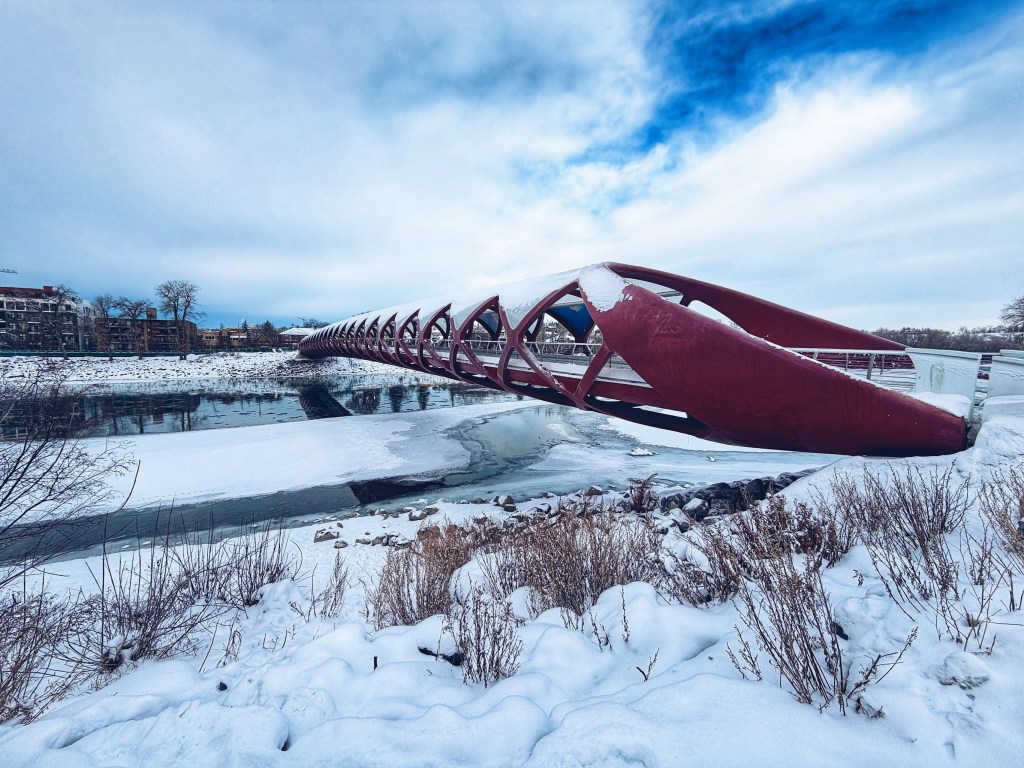
Our first destination is the Peace Bridge, a structure that has imprinted itself on my mind through photographs long before I set foot in Alberta. We park and step into the biting clarity of a Sunday morning. The world is monochromatic—a park buried in white under a sky of unyielding blue—save for that striking red helix slicing across the frozen Bow River. It’s a scene of arresting beauty, guarded by a brutal, stinging cold.
Defeated by the cold, the others retreat to the warmth of the vehicle. I, on the other hand, stay, driven by my own inability to stay put. Consulting Google Maps, I push deeper into the park toward a set of silent, snow-dusted arches. Around me, joggers and dog walkers keep moving. The red benches remain empty. In this weather, stillness is a luxury the winter does not permit.
I join the group a few minutes later, drive toward the Calgary Tower, and ascend it. From this vantage, the city confesses its nature: a vast, deliberate sprawl confident in its horizontal conquest. The density of buildings dissolves the farther the eyes go, eventually meeting the imposing line of the Canadian Rockies on the horizon. Stepping onto the glass floor, my stomach lurches unexpectedly. Even in a city of flat prairies, Calgary has found a way to unsettle my balance.
We wander the pedestrian corridor of Stephen Avenue before finding refuge in a mall food court. Over lunch, the dialogue drifts inevitably back to Joseph—graduation, the looming unknown, the vacuum that follows the end of academic structure. The city around us is an indifferent yet accommodating backdrop to our personal transitions.
Sensing time running out, I excuse myself from the group for another solo walk. I want to maximize my brief time in this city. I make my way south to Central Memorial Park, which today lays heavy under a duvet of snow, flanked by a library, a handsome church, and the Freemasons Hall. A few figures move sluggishly through the freeze; a homeless man sits tucked to one side, almost absorbed by the landscape. I am less about looking for specific landmarks than feeling the texture of the place, knowing I won’t have long with it.
I wander until I find a towering piece of urban art—a painting by German graffiti artist Mirko “DAIM” Reisser, reportedly the world’s tallest mural. Rising about 95 m on the east wall of the First on Tenth building at 123 10 Ave SW in Calgary’s Beltline, it’s a burst of color amid the monochromatic downtown skyline. Still, while it’s technically impressive, it’s strangely unremarkable. Perhaps not every corner of a new city needs to be iconic to be seen.
Before long, I circle back to the Calgary Tower where the others wait. As we walk to the car, we receive a message from Ate Dulce: they are already at the church with our parents, and the offer is open to join them.
And so, instead of returning to the hotel, we head toward the church.
The Immigrant Timeline: Faith, Food, and Reunion


We reach the church just past two in the afternoon.
It’s an Alliance congregation—evangelical in theology, yet distinctively Filipino in spirit. The congregation rents the building, using the sanctuary only in the afternoons, after the morning service of the mother church has ended. The hall itself is cavernous, swallowing the modest crowd, yet the emptiness feels negligible. The atmosphere is intimate, almost familial, as if everyone present understands exactly who this space is designed to hold.
We find our parents at the lobby, eating bowls of pho they bought from a nearby restaurant. Meanwhile, Ate Dulce is busy in preparation for the service, where Pastor Bong is the speaker. The Rojas family is still on their way from Edmonton, where they are based, driving south solely for this brief intersection of our lives.
We make our way inside the sanctuary. Soon, the praise and worship starts. I watch the musicians on stage. All have Filipino faces, some a bit older while some clearly raised here. I watch the children moving fluidly through the aisles, with English as their primary tongue and Tagalog an optional accessory. I wonder, not for the first time, what the Philippines looked like to them. Does it exist as a place at all, or only as a story their parents tell?
For them, Calgary isn’t a stopover. Neither it is a destination. It’s their world.
Once the service concludes, the room erupts with that specific, chaotic warmth found in Filipino gatherings as introductions are made and conversations spill outward. The Rojases finally arrive, and in that moment, the distance vanish. Seeing Pastor Dave and his wife Lala again feels less like a reunion after two years and more like resuming a meeting that ended only a couple of months ago.
There are reunions layered within reunions. Ate Lita spots Lala’s mother Mamba—once her neighbor back home, now transplanted halfway across the globe. They slip instantly into the vernacular of their old street. Different continent, same cadence. Then there’s Joseph and Odie, Pastor Dave and Lala’s son. The two joke around and tease each other like the months between them never existed. In that moment, time and distance were mere suggestions rather than barriers.
Inevitably, dinner follows. The Dabalos family invites the entire group back to their home, taking our parents with them. The Downtown Calgary squad follows them with the Rojas family. En route, we make a strategic stop at Seafood City—a Filipino grocery outpost in the middle of Calgary—and arrive carrying trays of food that shouldn’t make sense this far north: barbecue, palabok, karioka, lechon, ube cake. It doubles as a celebration for my father’s birthday, observed a day late but with no less fervor.
At the table sit the veterans—people who have been here for decades, who have learned the city well enough to stop questioning it. In the living room, we gather again on the couch: Joseph, Yanyan, Ate Lita, myself, and the children. We talk, laugh, eat. Two groups, two stages of life, occupying the same house.
I finally realize what this room holds. The laughter sounds the same. The food is identical. But the lives are separated by years of weather, paperwork, risk, and patience. More than a reunion, this is the entire immigrant timeline, compressed into a single snowy evening.
Jollibee Lunch at CrossIron Mills with the “Strivers”

The following day brings a distinct shift in tone.
Inside CrossIron Mills, the ambient energy is different. It’s lighter, more kinetic, and decidedly restless. We’re spending the day with the Rojas family, the “newcomers” still carving out their lives in Canada. I feel closer to them, if only because their stories are still warm to the touch, filled with the excitement and uncertainty of building something new.
We arrive at the peak of lunch, and the consensus is instantaneous: Jollibee. It isn’t the most convenient choice since it’s a bit of a walk from the sprawling food court, but it’s the one that calls the loudest. Yanyan and I navigate the queue while the others claim our space and wait. It’s a familiar ritual: no matter how many oceans you cross, you still know exactly what you want.
We convene in the cavernous food court, with trays tessellated across tables and conversations overlapping. Stories emerged, but beyond the polished retrospectives of success, there are raw details of adjustment and disappointment. Plans that didn’t unfold as cleanly as hoped. Pastor Dave talks about how they didn’t even start in Edmonton, how Saskatchewan came first, and how opportunities arrived sideways rather than straight on. He uses faith to frame the narrative, but he also points out how effort fills in the gaps.
Later, as our parents and the Rojas couple move on to more personal conversations, we excuse ourselves once more. The young-ish cohort drifts into the flow of the mall, driven more by restlessness than specific purchases. We buy nothing significant—small souvenirs, practical necessities, a gift for a Christmas party exchange, and so on.
And as unlikely as it sounds, CrossIron Mills serves as the ideal backdrop for this stage: a landscape of commerce and potential, a space for the small reward after a hard week, for visualizing rooms not yet fully furnished. If the Dabalos family and their suburban home shows stability, the Rojases in this mall possesses momentum.
Perhaps that explains my affinity for them. In a sense, they remain travelers. They’re no longer navigating airports, but they’re journeying to a new existence, mapping it out one careful decision at a time.
By the time dinner ends, goodbyes have been said. The Rojases turn their cars north toward Edmonton, while we drive to the airport for the return flight to Vancouver. Calgary recedes into the dark behind us. It’s a landscape defined by snow, relentless sprawl, and stories that are still in the process of being written.
In the short time we spend here, what stays isn’t the city itself, but the lifecycle of migration playing out simultaneously. There are the veterans anchored in stability, and there are the strivers pouring their foundations. Then there’s us, the transient witnesses, moving between both. If Vancouver gave me a snapshot of my brother finding his footing, Calgary provided the timelapse. It’s the full arc from those first, tentative strides to the unshakable confidence of decades passed.
Migration is rarely a singular event. Rather, it is a long passage composed of distinct seasons. For a fleeting window, I was able to see them all concurrently, leaving with pieces of me scattered across two vastly different eras of the same journey.
Calgary Travel Basics
Timing
- The best time to visit Calgary depends largely on what you want to experience. July and August are peak months. The weather is warm and dry (highs around 20°C to 25°C), and parks are bustling. There’s also the Calgary Stampede (usually the first two weeks of July). This is the city’s biggest draw, turning Calgary into a massive party. Book hotels months in advance if visiting during this time.
- If you plan to visit the nearby Rocky Mountains (Banff/Lake Louise), the best window is late June to September. Late September in particular is “Larch Season,” when the alpine needles turn into a spectacular golden yellow.
- The “shoulder” months of May and October offer decent weather (though unpredictable snow is possible) with significantly cheaper accommodation rates than the summer peaks.
- Winter gets very cold: expect temperatures to frequently drop between -10°C and -20°C (14°F to -4°F), with cold snaps reaching -30°C. However, Calgary has a unique weather phenomenon called a Chinook. These are warm winds from the Pacific that can raise the temperature by 20 degrees in a single day, melting snow and making the day relatively warmer. Also, Calgary is the sunniest major city in Canada: even on the coldest days, the sky is usually a piercing, bright blue.
Access
- By plane:
- Most visitors arrive at Calgary International Airport (YYC), the city’s main gateway, situated about 17 km (10 mi) northeast of downtown. Handles both domestic and international flights, with direct connections from Vancouver, Toronto, and several U.S. cities.
- From here: a taxi or ride-hailing service takes roughly 25–30 minutes and costs around CAD 40–50. Public transit (Route 100 bus to the nearest CTrain station) is a slower but cheaper alternative, taking about 45–60 minutes.
- By Road:
- From Banff:
- Around 90–100 minutes via Trans-Canada Highway (Highway 1).
- Scenic route along the foothills of the Rockies.
- Winter driving requires caution; snow tires or AWD/4×4 recommended.
- From Edmonton:
- Around 3 hours via Queen Elizabeth II Highway (Highway 2).
- From Banff:
- By Train (via VIA Rail):
- VIA Rail: Limited service. Offers scenic prairie views but takes longer than driving. Note that the train stops at Edmonton. From Edmonton, you need to take a bus to Calgary. Economy train fares on routes like Toronto to Edmonton often start around CAD 400–600 one‑way, with higher fares for sleeper cabins or upgraded classes.
- By Bus:
- Red Arrow: Serves Calgary from other Alberta cities like Edmonton, Red Deer, and Banff. Comfortable and cost-effective but slower than driving. One‑way fares average around CAD 70–80 and a journey of about 3–4 hours.
Transportation
- The CTrain light rail system forms the backbone of the city’s transit, with two main lines connecting downtown to northern and southern suburbs.
- Single adult ride: CAD 3.50–3.75, depending on time of day
- Day pass: CAD 10.50 (unlimited rides for the day)
- Monthly pass: CAD 109–116 for unlimited travel across all zones
- Buses complement the rail network, reaching neighborhoods and attractions the CTrain doesn’t. Bus fares match the CTrain fares: single ride CAD 3.50–3.75.
- For visitors who prefer flexibility, driving is a convenient option. Roads are generally wide and well-maintained, though downtown traffic can be heavy during peak hours. Ride-hailing services like Uber and taxis are widely available and useful for short hops or when public transit schedules don’t align.
Accommodation
- Days Inn by Wyndham Calgary Airport – A practical, budget‑friendly choice near Calgary International Airport and a short drive from downtown. It offers complimentary breakfast, free Wi‑Fi, an indoor pool and fitness facilities. Convenience and comfort without a premium price. Around CAD 70–100 per night for standard rooms, depending on season and availability.
- Hyatt Regency Calgary – Great for travelers who want comfortable downtown accommodation close to Stephen Avenue, restaurants, and city attractions. Well‑reviewed mid‑range option that balances style, location, and service for both leisure and business stays. Often around CAD 178–CAD 285+ per night, depending on room type and timing.
- Le Germain Hotel Calgary – A higher‑end boutique choice in the city center with refined design and excellent service. For a more luxurious or memorable stay during your Calgary visit. Around CAD 150–CAD 240+ per night, depending on room type and season.
Food
- River Café offers a unique setting: right in the middle of Prince’s Island Park on the Bow River. You actually have to walk through the park to get to the restaurant, which feels like a rustic-chic lodge hidden in the trees. They are pioneers of “farm-to-table” in Calgary, focusing exclusively on seasonal, locally sourced Canadian ingredients (bison, sustainable fish, Saskatoon berries).
- Homegrown OEB Breakfast Co. has become legendary for elevating breakfast into a main event. While there are a few locations around the city, the downtown branch is the most convenient. Expect a lively, fast-paced environment with huge portions.
- Major Tom Bar is one of the most chic in options, located on the 40th floor of Stephen Avenue Place. It offers a panoramic view of the skyline and the Rocky Mountains, making it an ideal choice for a special dinner.
- For the ultimate Pinoy connection, Seafood City Supermarket is the largest Filipino grocery chain in North America—its main hub in Calgary is called “Little Manila.” Inside are stalls selling Filipino favorites, including Grill City (BBQ pork liempo and chicken inasal), Crispy Town (snacks like okoy and chicharon), and Valerio’s Tropical Bakeshop (hot pandesal and ensaymada). Located at Sunridge Way NE.
For more practical information, visit Tourism Calgary’s official website.
 The Tourist Gaze