
West of Milagros lies Mandaon. There’s not much information I could get online about it except some mention that it’s a coastal town with strips of beaches, although they’re too far that it will probably be after sunset when we reach them. There are no proper accommodations for travelers, and since it’s a holy weekend, a ride back to Masbate City would be virtually impossible without having to pay a large amount for another special trip. So, Marlon, my motorbike driver, takes me as far as the Bat-ongan cave, located just off the highway between the beaches and the border with Milagros.
Bat-ongan Cave is one of the few caves in Masbate that has both historical and geological significance. Locals believe it was once used as a hideout during wartime, and its multi-level chambers make it stand out from other caves in the region. The cave is also home to interesting rock formations, giving it an almost otherworldly feel.


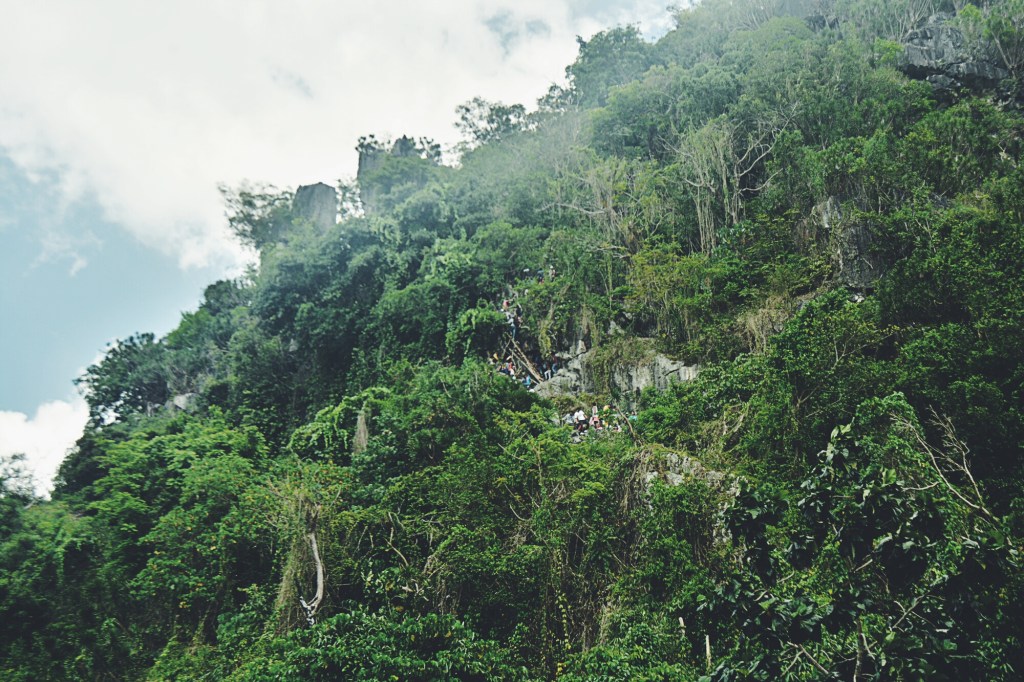
The cave is located in a mole-like mountain that juts out of the ground in the middle of a large field. Approaching the mountain, its imposing presence gradually looms large, dwarfing the people climbing it and the motorbikes parked at its base. A swarm of Good Friday visitors are constantly streaming through the narrow paths going to the cave, which gives the place a bustling vibe, something I have hardly experienced so far throughout my stay here in Masbate.
How to Get to Bat-ongan Cave from Masbate City
- From Masbate City, take a van or habal-habal (motorbike) to Mandaon town. Travel time is around 1–1.5 hours.
- From Mandaon town proper, you can hire a local guide or a habal-habal to take you to the cave entrance.
What to Expect Inside the Cave
- Multi-level chambers: Unlike many caves in the country, Bat-ongan has multiple floors, adding to its mystery.
- Natural rock formations: Stunning stalactites and stalagmites fill the cave, shaped by time and nature.
- Echoing chambers: Some sections of the cave produce eerie echoes, enhancing the adventure.
- Historical significance: Folklore suggests it was once a shelter for locals during conflicts.


 The Tourist Gaze
Leave a reply to jayexiomo Cancel reply