
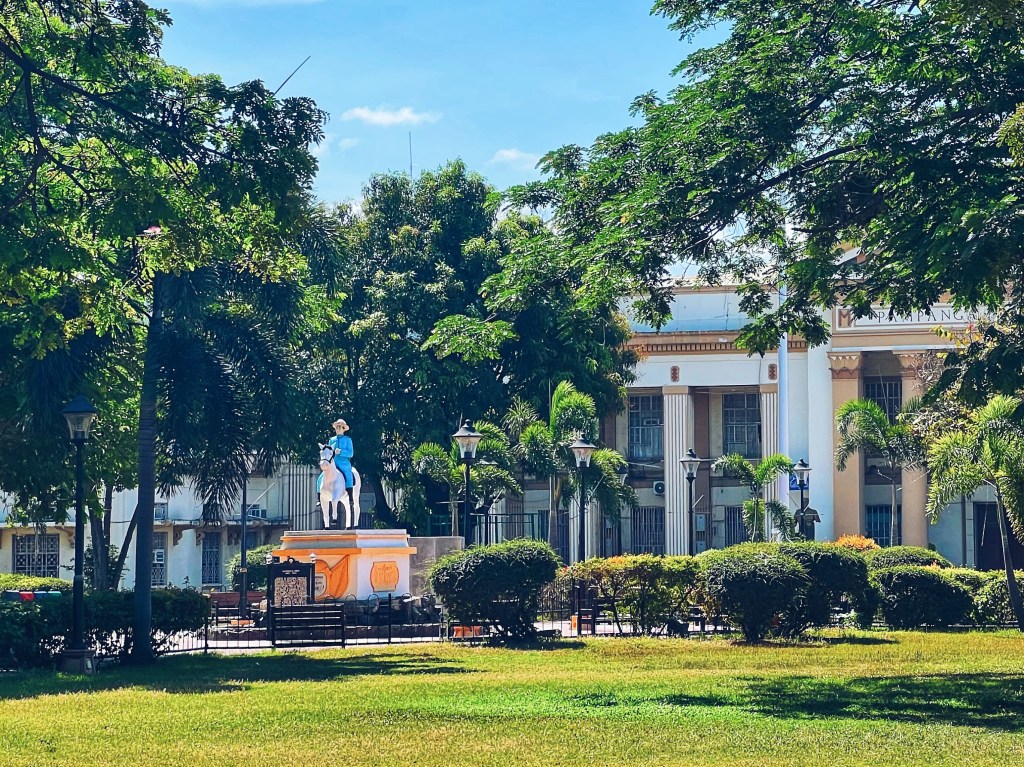
Sometimes, you don’t need a reason to go on a trip—just the urge to go for a drive. My dad needs a break from the usual routine, and as I settle into my 40s, I’ve been feeling a pull toward familiar places with fresh eyes. So, on a weekend, we set off on a road trip to San Fernando, Pampanga, a place that I’ve been a few times before for various reasons—from witnessing penitents whip themselves to experiencing a drive-in cinema in the height of the pandemic and joining a historic political rally.
Yet, no matter how many times I return, San Fernando keeps pulling me back. With its blend of history, culture, food, and fun, it’s a perfect stop when heading north of Metro Manila. What’s not to love?
The plan today is simple: spend the morning exploring the city’s past with my dad, revisiting heritage sites and classic eats, before shifting gears in the afternoon toward modern attractions like SM Pampanga and SkyRanch—though that last stop would be mine alone. (Side note: My dad and I also went on a road trip last year to Bataan!)
McDonald’s Capital Town: The Biggest McDonald’s in the Philippines… Or So They Say


After an uneventful one-hour drive along NLEX, we arrive in San Fernando. We kick off our city trip with breakfast at McDonald’s Capital Town. Located in the heart of San Fernando’s Capital Town development, this massive branch boasts stylish interiors, high ceilings, and a modern aesthetic that blends with the area’s historic charm. Some news sources said it’s the biggest McDonald’s in the Philippines, but it’s hard to find details or an official confirmation from McDonald’s itself.
Anyway, while my dad settles into the adjacent McCafé with his coffee, I order two Sausage McMuffins with Egg to go, along with apple juice, since my indigestion means I have to refrain from soda for now. We ate at McCafé, where the quieter ambiance makes for a relaxing start to the day. It isn’t a groundbreaking meal, but there’s something about road trips that make fast food breakfast feel like part of the adventure.
San Fernando Train Station: History, Restoration, and WWII Museum

While my dad takes his time sipping his coffee and eating his McMuffin, I go on a walking tour of downtown San Fernando. I first stop by the San Fernando Train Station, a place I explored with a couple of friends four year ago—on the eve of my birthday, no less. (I never got around to writing about it then. It was the pandemic, and I was dealing with relationship problems, so I was anxious and heartbroken… char.)
The train station, located on a street fronting the Pampanga Provincial Capitol grounds, was still a museum, untouched by the construction work happening now. I can still remember me and my friends going through its halls and reading about its part in World War II and imagining what happened here in the past. As part of the North-South Commuter Railway (NSCR) project, the stop is being renovated right now. “The PNR is being built as part of the NSCR project, which also includes showing off the historic station, which is a museum and important feature for the city,” the San Fernando Tourism Office says.
Even with these changes, it will still have historical value. “The San Fernando Train Station will remain as a World War II Museum,” the Tourism Office adds. In other words, the station will finally be brought up to date with new rail technology, but it will still be a reminder of its long and interesting history.
When the Manila-Dagupan line shut down in 1988, this was the last place where trains stopped. “In 1988, the PNR stopped running the Manila-Dagupan line and left its buildings,” the Tourism Office says. After World War II and other natural disasters over the years, damage had already been done to operations.
Just like people, places change over time. There will still be a museum here about the past, even though it will soon be part of a big traffic project. Having seen this change happen in just four years, I wonder how much of its old beauty will still be there when it reopens in 2027.
Walking Through Time: The Heritage Houses of San Fernando


Further along, I arrive at the downtown streets of San Fernando, which are filled with relics from the past, including ancestral homes that serve as a constant reminder of the city’s long and illustrious history. Strolling by these historic homes, one tends to imagine what life was like in the early 1900s, when these magnificent residences were owned by notable Kapampangan families.
The Hizon-Singian House, built in 1870 by Victoria Singian de Miranda and Don Anacleto Hizon, has witnessed key moments in history. It was occupied by Spanish General Antonio Ruiz Serralde during the 1896 Revolution, used as a Japanese military hospital in 1943–1944, and later served as the headquarters of American General Walter Krueger’s 6th Army in 1945. Passed down through generations, it was eventually owned by Gerry Catalino Rodriguez Y Hizon, former Pampanga Sugar Development Company president. Recognizing its historical significance, the National Historical Institute declared it a Heritage House in 2003.
Nearby stands the Lazatin House, which was built in 1925 by Serafin Lazatin and Encarnacion Singian, and a well-preserved example of American colonial-era Bahay na Bato architecture. During World War II, it was occupied by the Japanese Imperial Army and served as the residence of General Masaharu Homma. After the war, the Lazatin family restored the home, which had suffered significant damage. Recognized for its historical value, the National Historical Institute declared it a Heritage House in 2003, ensuring its exterior remains unchanged. Today, it is still owned by the Lazatin family.
Casa Nicolasa, also known as the Henson-Hizon House, holds the distinction of being the first Bahay na Bato built in San Fernando, Pampanga. With its ornate architectural details, it remains an impressive landmark, drawing admiration from visitors. In 2003, the National Historical Commission of the Philippines (NHCP) declared it a Heritage House, recognizing its historical and cultural significance.
Despite being privately owned, tourists can view the house, though it carries more than just history within its walls. Local stories speak of eerie occurrences, such as a mysterious lady by the window and an unseen pianist playing on its own. Whether these tales hold truth or are simply part of its mystique, Casa Nicolasa continues to stand as a testament to San Fernando’s past.
I continue walking until I find myself in front of the Metropolitan Cathedral of San Fernando, an imposing building that has served as the city’s spiritual hub for centuries. The church, which was first constructed in 1755 by the Augustinians, has undergone multiple restorations as a result of earthquakes and fires. In 1948, the current Neo-Renaissance architecture was finished. The cathedral’s imposing exterior, tall bell towers, and elaborate interior design all pay homage to Pampanga’s rich Catholic tradition. In sharp contrast to the bustling streets outside, the solemn mood indoors encourages peaceful contemplation.
A short walk from the cathedral leads me to the San Fernando City Market Plaza, a modern extension of the old city market. A section of the market has been converted into a food park, providing a welcoming area for foodies, even if it is still the place to go for local products and fresh fruit. With communal tables set up for informal dining, rows of booths offer everything from modern street food to traditional Kapampangan specialties. All the foods surrounding me are tempting, but I’m saving space in my tummy for lunch with my dad.
A Taste of Kapampangan Tradition: Lunch at Bale Capampangan


With its bold flavors, rich sauces, and masterful use of local ingredients, Kapampangan cuisine is often hailed as one of the best in the Philippines. In fact, Pampanga is known as the “Culinary Capital” of the country, and Bale Capampangan, a well-loved buffet restaurant, is a great place to experience that famed Kapampangan cooking.
My dad and I stop by this restaurant for lunch, just as we did many times in our previous trips to the city. Parking is a challenge, especially on a weekend noon. But the dishes that greet us inside assure us that the hassle is worth it. Sizzling on a hot platter, the sisig—the most famous delicacy from Pampanga—is crunchy and aromatic. The sweet-savory tocino, a morning staple in the Kapampangan cuisine, and the peanut-based oxtail stew, kare-kare, are also on the buffet spread. Lunch is completed with dessert selections like as halo-halo and tibok-tibok, a milk pudding made from carabao.
Eating at Bale Capampangan always feels like being invited to a party in a Kapampangan home, complete with delicious cuisine and wonderful people, thanks to its rustic decor and lively environment.
Sipping Local Brews: Coffee Break at Primero Coffee PH

After a hearty Kapampangan lunch that had my stomach on the verge of another dyspepsia attack, my dad and I head to Primero Coffee PH, a quiet café nearby, for a relaxing coffee break. This coffee shop, which has locations in several Pampanga towns, takes pride in using locally sourced beans, highlighting the Philippines’ rich coffee legacy.
The café’s pleasant, minimalist design makes it an inviting spot to unwind. My father orders a basic Americano, which he enjoys for its strong, straightforward flavor, while I have a cup of decaf Spanish Latte, which is creamy and slightly sweet. We tuck ourselves into a corner table, appearing out of place among the Gen Z throng that fills the establishment.
Nonetheless, Primero Coffee PH, with its inviting design and high-quality local brews, is a great place to unwind, have a cup, and have conversations on life and less heady topics.
SM Pampanga & SkyRanch: Exploring One of the Longest SM Malls in the Philippines

After immersing ourselves in San Fernando’s rich history and culinary delights, I explore the modern side of the city at SM Pampanga and SkyRanch Pampanga. As the longest mall in the province—and one of the longest in the country—SM Pampanga has transformed the city’s landscape, providing easy access to shopping, dining, and entertainment. With a vast selection of stores and restaurants, it’s a convenient stop for both locals and travelers. Meanwhile, my dad opts for a more relaxing experience, getting a foot massage at a nearby spa.
Right next to the mall is the SkyRanch Pampanga. The amusement park, located in the SM parking lot, has become a must-visit attraction, particularly for families with kids. “SkyRanch Pampanga has boosted tourism in San Fernando by attracting visitors with the diversity of local attractions that support local businesses,” according to the city’s tourism office, adding that “it was even recognized as the top tourist attraction in Central Luzon in 2022.”
Last year, when I went here with a friend, we rode a couple of rides, unmindful of the fact that we’re 30-somethings among teenagers and families. But today there’s no way I’m riding on my own with these young people, hahaha! So I simply take a stroll through the park, watching as visitors enjoy rides like the Pampanga Eye, which is reputed to be the largest Ferris wheel in the country and offers panoramic views of the city. The park is filled with senior high school students, some coming from as far as Batangas, and this reminds me of the field trip we had in Enchanted Kingdom late last year.
A Cozy Cap Off: Dining at SOUQ Pampanga, a Rustic Culinary Gem


My dad and I conclude our San Fernando trip in SOUQ Pampanga, a restaurant famed for its quiet, rustic ambiance and a menu that combines Kapampangan and international cuisines. The warm lighting, timber furniture, and sophisticated yet domestic design provide a welcoming atmosphere ideal for a relaxing evening.
Still full from our buffet lunch, we content ourselves with Sicilian Salad, a refreshing blend of greens, fruits, and nuts that strikes a balance between lightness and flavor. My dad even likes the nuts so much he asks if the restaurant sells it. Diners who have more room for a feast, though, can try SOUQ’s Crispy Pata, Beef Kansi, and Seafood Paella, all of which come in substantial servings that are ideal for sharing.
Whether it’s a casual meal or a celebratory gathering, the restaurant’s refined yet cozy ambiance nicely rounds out a day of seeing San Fernando.
As the sun sets over the city of San Fernando, my dad and I are finally heading home. This trip transcends the mere act of rediscovering San Fernando’s history and food scene. Time really flies, and hitting 40 has made me more aware of the importance of cherishing these moments shared with him.
I guess this type of trips will be the recurring theme through my 40s. It’s not about the places themselves (although I still want to visit new places if time and budget allow), but the time spent with people who matter as we weave together memories while we explore.
San Fernando, Pampanga Travel Basics
Timing
- Weekends are best to avoid Metro Manila traffic (leave early).
- Weekdays are quieter at restaurants and malls.
- December sees the Giant Lantern Festival (Ligligan Parul). Peak crowds, but a must-see.
Access
- By car: NLEX; ~1.5–2 hrs from Manila. Exit at San Fernando.
- By bus: Victory Liner, Genesis, or Bataan Transit from Cubao/Pasay. Fare PHP 150–200.
Transportation
- Tricycles: PHP 20–50 for short trips.
- Jeepneys: PHP 13 (short distances).
- GrabCar: Convenient air-conditioned option.
Admission
- Heritage houses: Fees vary. Check with the City of San Fernando, Pampanga Tourism Office.
- SkyRanch Pampanga: Free entry. Rides PHP 50–250. Ride-all-you-can pass: PHP 350 (15 rides).
Food
- Bale Capampangan – Buffet of local classics (sisig, bringhe, morcon). PHP 599/adult, PHP 399/child.
- SOUQ – Modern Kapampangan dining with crispy pata, kare-kare, tibok-tibok.
Accommodation
- Azure North: Studio-style condos near SM Pampanga, pool & city views. From PHP 2,250/night.
- Microtel Pampanga: Family-friendly hotel with spacious rooms, convenient location. From PHP 4,500/night.
For more practical information, consult the City of San Fernando, Pampanga Tourism Office.
 The Tourist Gaze