
AS KIND AND I leave Surallah behind, the slow pace of rural Mindanao takes over. Rice fields stretch until the point near the horizon where Mount Matutum seems to grow. Children run around the side of the road. Jagged coconut trees and wooden houses dot the otherwise green landscape. Once again, I’m having that particular brand of excitement that I get every time I embark on an adventure.
I get off the motorbike for a few minutes at the town center, where a few stalls sell meals, canned drinks and souvenir items. There’s a large “I Heart Lake Sebu” on a fence that encloses the majestic statue of what I presume to be a local hero or a former leader. In a nearby park, throngs of people are crowded in a covered area. Kind tells me they’re the recipient of a local cash grant handed by the government to indigent families. It seems it is a morning like any other for the locals.
We make our way to Punta Isla Lake Resort near the lake’s southern end and the drive is idyllic. The blue sky interrupted by large tufts of clouds backdrop the bamboo-lined dirt paths. Maybe except for the sound of Kind’s motorbike, the place is silent in a pleasant way.
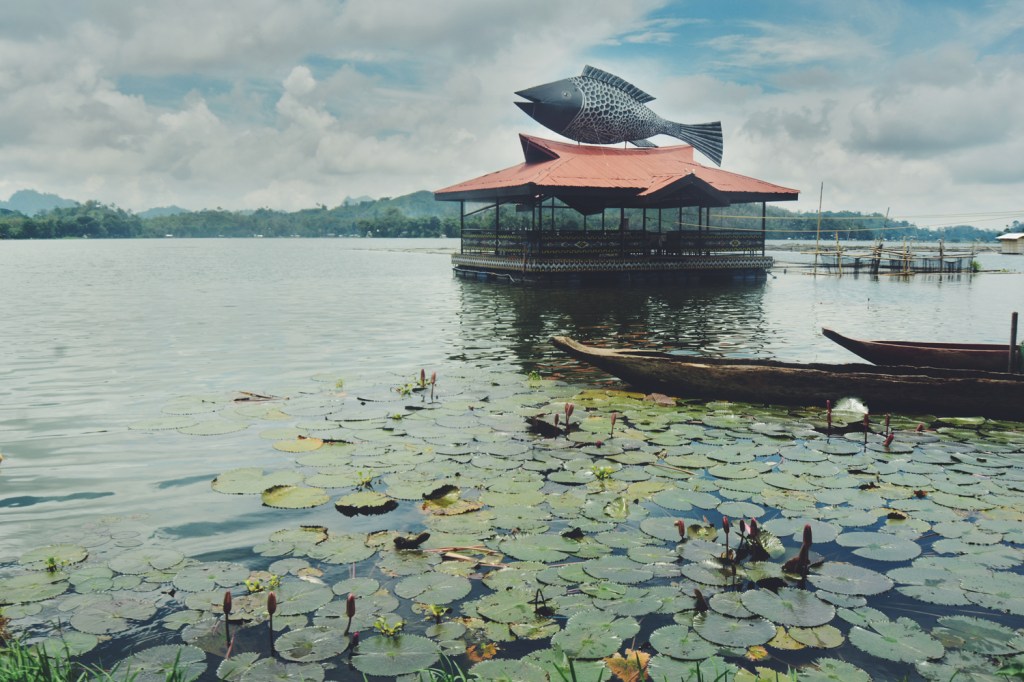
We arrive at the lakeside resort just before noon, in time for our lunch. We are welcomed by a group of T’boli girls who immediately burst into a song and dance number. Below us, a boat comes to life and slowly takes a group of tourists on a tour around the lake. Boys are swimming in the placid water.


The tranquility of the town makes for a perfect backdrop for the newly opened Divine Mercy Retreat House in the village of Lamdalag, our next destination. Perched on a hill with a large statue of Christ overlooking a pretty garden, the site provides a scenic venue for visitors looking for tranquility and some time to commune with God.
Nonetheless, the Catholic venue seems incongruous here. With its remote location and abundance of natural resources, the area around Lake Sebu has made it easy for the T’bolis to retain their traditions. Cut off from the rest of the world, the T’bolis have turned to the placid lake and their resilience to keep their culture alive. Lake Sebu, located in the heart of the Allah Valley, have provided irrigation supply not just for the municipality but to the province as well.
The lake’s significance has naturally caught the attention of outsiders as well, and the national government is now actively promoting it as one of the country’s ecotourist destinations. The Department of Tourism’s slogans are actually deserved. The surrounding nature is, simply put, beautiful.
Though I’ve fallen for the sight of the morning sun peeking through the panoply of trees, and of the lilies and wooden canoes in the lake, it’s the locals’ warmth that permanently takes a place in your mind.
The T’bolis are among the area’s original settlers, but the arrival of immigrants have forced them to move to the mountains, living in scattered communities and keeping to their traditional ways, relatively unchanged even after centuries. Most T’bolis remain animistic and take their inspiration from nature, believing that everything around them possesses a spirit and must, thus, be respected.


The T’bolis are also easily distinguished from other neighboring tribes by their elaborate clothes and ornaments. Known as t’nalak, the T’boli’s sacred tapestry is woven using abaca and undergoes a tedious process before it can be worn.
T’boli women are taught the art of weaving the t’nalak at a very young age and the process of learning is made more difficult by the absence of preexisting guides or patterns. The designs are taken from images the T’bolis claim come from their dreams; hence, they are called “dreamweavers.”
Most prominent of these dreamweavers was Lang Dulay, who died of stroke in May 2015. Lang Dulay was declared a National Artist by the National Commission for Culture and the Arts (NCCA) for her contributions to the art of textile weaving. In conferring the award, the NCCA noted “the close interweaving of the warp and weft, the traditional forms and patterns, the chromatic integrity of the dye, and the consistency of the finish.”


Just before we leave Lake Sebu, Kind takes me to one of the newest attractions in the area – the zipline which takes visitors soaring high above a stretch of the lush forest and providing views of three of the seven waterfalls in the area.
The best of these falls is the Hikong Bente, or Falls No. 2, which can be easily reached from the parking area and the landing spot of the second zipline. Kind and I spend a few minutes marveling the cool waters tumbling from a 70-meter drop before flowing through a river that cuts through what looks like Middle Earth.
As I walk back to the parking lot with Kind, the sun casts the sky in a deep shade of blue as a slight breeze sends the trees gently swaying. Entranced by the quiet rhythms of the place, I decide that as of this moment, this is where I want to be.


 The Tourist Gaze
Leave a reply to jayexiomo Cancel reply